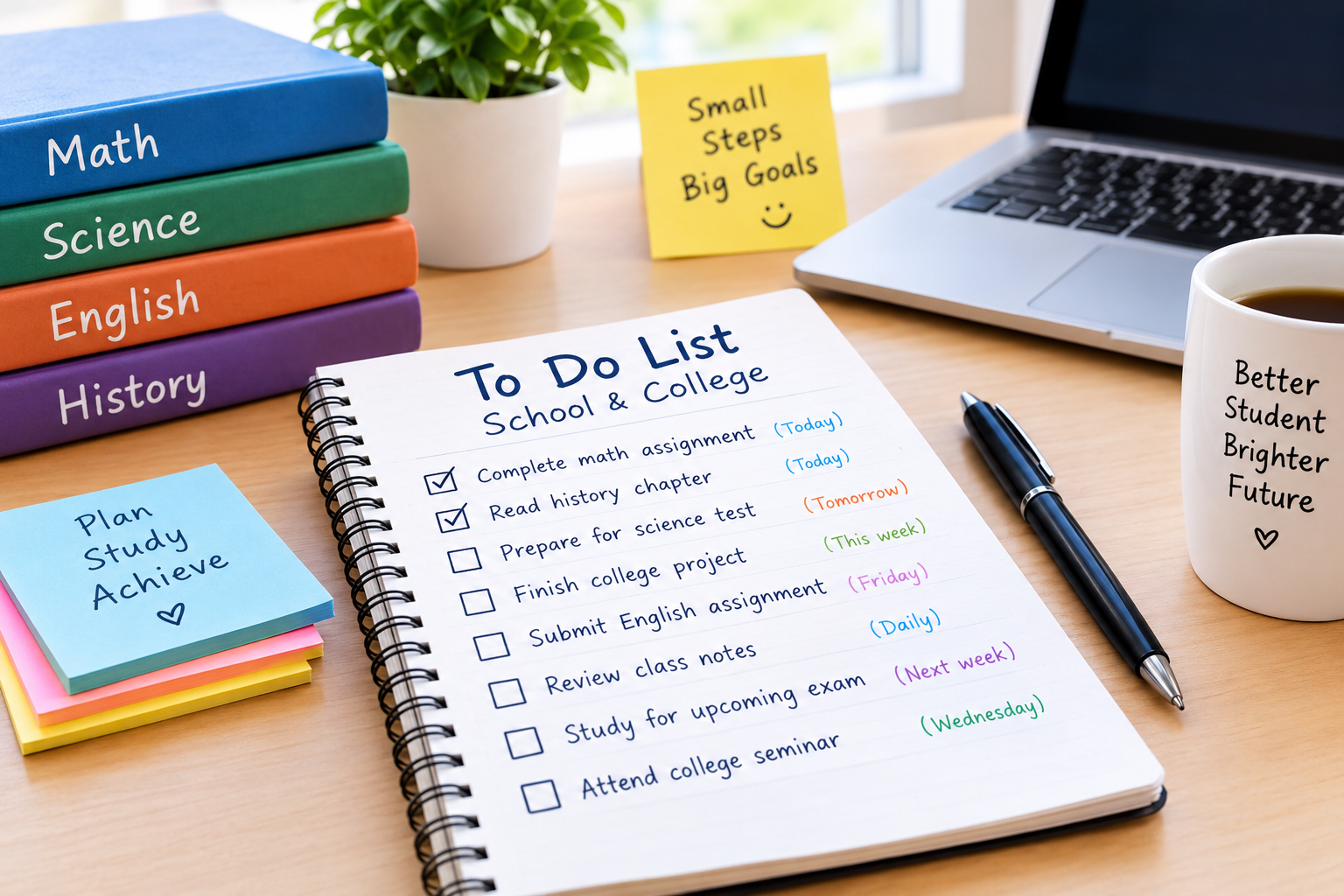
Managing school or college work can sometimes feel difficult, especially when you have assignments, homework, exams, projects, classes, and personal activities happening at the same time. I have found that one of the simplest ways to stay organized is to use a to do list.
A to do list does not need to be complicated. It is simply a place where I write down the tasks I need to complete. When I can see everything clearly, it becomes easier for me to decide what needs my attention first.
In this article, I will explain how to use a to do list for school and college, how to organize your tasks, and how to make your daily study routine easier.
What Is a To Do List?
A to do list is a simple list of tasks that you want to complete during a specific period. You can create a daily to do list, weekly to do list, or even a monthly list.
For students, a to do list can include many different activities. For example, you may need to complete a mathematics assignment, read a chapter, prepare for a test, attend a class, work on a college project, or submit an important form.
The main purpose of a student to do list is to put these responsibilities in one place instead of trying to remember everything in your head.
Why Students Should Use a To Do List
I believe a to do list can make student life much more manageable. One major benefit is that it gives you a clear picture of what you need to accomplish.
When I write my tasks down, I do not have to keep thinking about them repeatedly. This can make it easier to concentrate on the task I am currently working on.
A to do list can also help prevent missed deadlines. If an assignment is written on the list with its due date, there is a better chance that you will remember it before the deadline arrives.
Another benefit is motivation. Checking a completed task can give you a feeling of progress. Even small accomplishments can encourage you to continue working.
Start With Everything You Need to Do
Before creating a daily student to do list, I recommend making a complete list of your current responsibilities.
Think about your school or college classes, assignments, projects, exams, reading tasks, presentations, and other important activities.
Write everything down without worrying about the order at first. This gives you a complete picture of your workload.
For example, your list might include:
Complete science homework
Read two chapters of history
Prepare for mathematics test
Finish college presentation
Review class notes
Submit assignment
Once everything is written down, you can organize the list according to importance and deadlines.
Separate Important Tasks From Small Tasks
Not every task on your to do list has the same level of importance. Some tasks may have deadlines tomorrow, while others can wait several days.
I find it helpful to identify the tasks that require immediate attention.
For example, if you have an assignment due tomorrow and a project due next week, the assignment should probably receive attention first.
However, this does not mean that you should ignore larger projects until the last minute. A better approach is to give important long term projects smaller tasks that you can complete throughout the week.
Break Large Assignments Into Smaller Tasks
One of the most useful to do list tips for students is to break large assignments into smaller steps.
A task such as “finish college project” can feel overwhelming because it is too broad.
Instead, you can write:
Choose project topic
Research information
Create an outline
Write the first section
Complete the remaining sections
Review the project
Prepare the presentation
Submit the project
Each step feels easier to manage. Completing several small tasks can also make a large project feel much less stressful.
Create a Daily To Do List
A daily to do list should contain the tasks you realistically expect to complete that day.
I recommend avoiding extremely long lists. If you put twenty tasks on your list, you may become frustrated when you cannot finish everything.
Instead, choose a few important tasks and add smaller tasks around them.
For example, a simple daily student to do list could look like this:
Review mathematics notes
Complete English assignment
Read one chapter
Practice questions for tomorrow’s test
Organize notes for college project
This type of list is easier to understand and follow.
Add Deadlines to Your Tasks
Adding deadlines can make your to do list more useful. Whenever an assignment, project, or presentation has a specific due date, write it beside the task.
For example:
Submit biology assignment by Thursday
Prepare presentation by Friday
Complete reading before Monday
Deadlines help you understand which tasks need attention first. They can also reduce the chance of forgetting important school or college work.
Use Time Estimates
Another useful habit is to estimate how long each task might take.
For example, you might expect mathematics homework to take one hour, while reviewing notes may take thirty minutes.
Time estimates help you create a realistic study schedule. They also make it easier to decide how many tasks you can complete in one day.
Remember that your estimates do not have to be perfect. They are simply there to help you plan your time.
Choose the Right To Do List Method
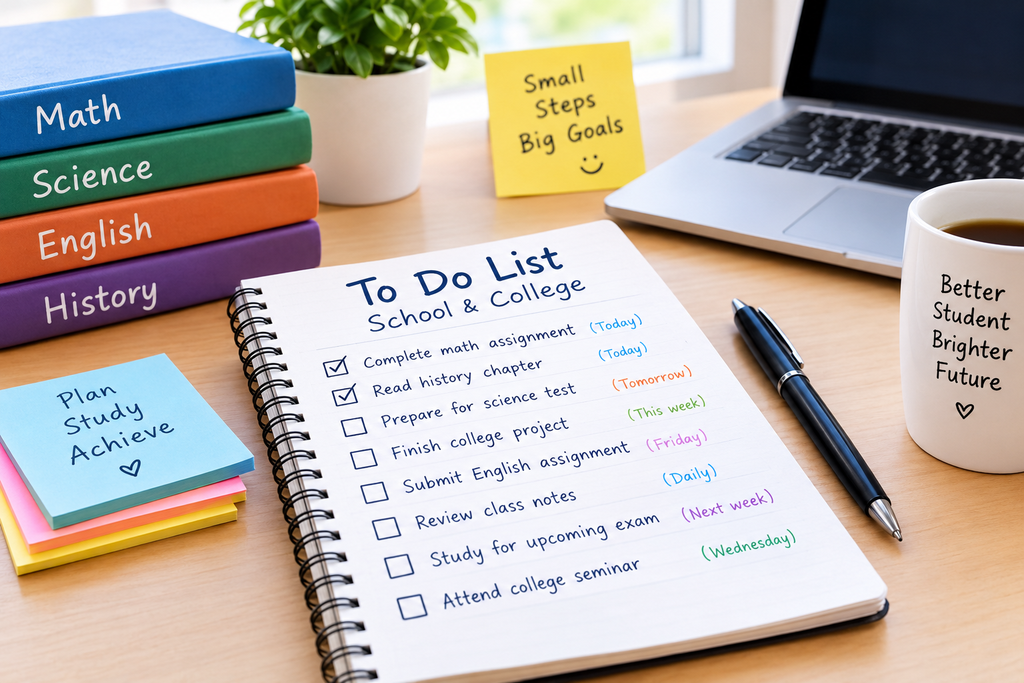
There are many ways to create a student to do list. You can use a notebook, planner, phone application, computer application, or simple digital document.
I personally think the best method is the one you will actually use consistently.
Some students enjoy writing tasks by hand because it feels more natural. Others prefer digital to do list tools because they can easily edit tasks and set reminders.
You can try different methods and choose the one that fits your study routine.
Keep School and College Tasks Together
If you use multiple notebooks or applications for different subjects, important tasks can sometimes become difficult to track.
A simple solution is to keep your main tasks in one central to do list.
You can still organize the list by subject. For example, you could have sections for mathematics, science, English, history, or college projects.
This allows you to see your complete workload without checking several different places.
Review Your List Every Morning
I recommend checking your to do list at the beginning of each day.
Look at your deadlines and decide which tasks are most important. Then adjust your list according to your available time.
If something unexpected happens, do not feel bad about changing your plan. Student life can be unpredictable, and your to do list should help you rather than create additional pressure.
Review Your List Before Sleeping
A quick evening review can also be helpful.
Check which tasks you completed and move unfinished tasks to another suitable day.
You can also look at tomorrow’s responsibilities and prepare yourself in advance.
For example, if you have a test tomorrow, you may decide to spend some time reviewing your notes before going to bed.
This simple habit can make the next morning feel more organized.
Do Not Put Everything on Your List
A common mistake is turning a to do list into a list of every tiny activity.
You do not need to write down every small action you take during the day. Focus on meaningful tasks that require your attention.
For example, instead of writing every step of getting ready for class, simply write “prepare for morning class.”
Your list should make your day clearer, not more complicated.
Use Your To Do List With a Study Schedule
A to do list tells you what you need to do, while a study schedule can help you decide when to do it.
Using both together can be very effective.
For example, you might schedule mathematics practice from 4:00 PM to 5:00 PM and English reading from 5:30 PM to 6:00 PM.
Then you can use your to do list to track those tasks.
This approach can help you create a more organized study routine without making it unnecessarily complicated.
Make Time for Breaks
A good student to do list should not contain only academic work.
Breaks are also important. You need time to eat, relax, spend time with family, exercise, and enjoy your hobbies.
If you plan every minute of your day without allowing yourself time to rest, it can become difficult to maintain the routine.
I prefer to keep my study tasks realistic and leave enough space for normal daily activities.
What to Do When You Cannot Finish Everything
Sometimes you will not complete every task on your list. That is completely normal.
Instead of becoming discouraged, look at the unfinished tasks and decide whether they are still important.
Move them to another day if necessary. If a task is no longer relevant, remove it.
The purpose of a to do list is not to make you feel guilty. Its purpose is to help you manage your responsibilities.
Final Thoughts
Learning how to use a to do list for school and college can be a simple but useful step toward better organization.
Start by writing down everything you need to accomplish. Then prioritize important tasks, add deadlines, break large assignments into smaller steps, and create a realistic daily list.
You do not need an expensive planner or complicated productivity system. A notebook and pen can be enough to get started.
The most important thing is consistency. When you regularly write down your school and college tasks, review your list, and adjust it when necessary, it becomes easier to understand your workload and manage your time.
In my view, the best to do list is not the one with the most features. It is the one that is simple enough for you to use every day. Start small, keep your tasks clear, and gradually build a system that works for your own student life.