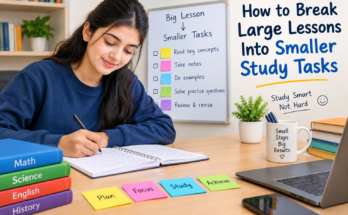

Studying does not always have to mean sitting at a desk for many hours. In my experience, the way we study is often more important than the number of hours we spend with our books. Many students spend a lot of time reading but still struggle to remember what they learned. The good news is that simple study techniques can make learning easier, more organized, and more enjoyable.
Every student has a different learning style, so there is no single study method that works perfectly for everyone. However, some basic techniques can help almost anyone improve concentration, memory, and understanding. In this article, I will share some simple study techniques for students that I believe are practical and easy to use in daily study routines.
Create a Simple Study Schedule
One of the first study techniques I recommend is creating a simple study schedule. Without a plan, it is easy to waste time deciding what to study. A schedule gives your study time a clear direction.
You do not need a complicated timetable. Start by writing down your subjects and deciding when you will study each one. Give more time to subjects that you find difficult and less time to subjects that you already understand well.
For example, you might study mathematics in the morning, English in the afternoon, and science in the evening. The important thing is to create a routine that you can actually follow.
A realistic study schedule is better than a perfect schedule that you cannot maintain.
Study in Short Sessions
Studying continuously for several hours can make you tired and reduce your concentration. One simple technique is to divide your study time into shorter sessions.
For example, you can study for 30 to 45 minutes and then take a short break. During the break, stand up, drink some water, walk around, or simply relax your eyes.
Short study sessions can help you stay focused because your mind knows that a break is coming. I personally believe that focused study for a shorter period is often more useful than sitting with a book for hours without concentration.
Use Active Recall
Active recall is one of the most useful study techniques for students. Instead of reading the same information again and again, you try to remember it without looking at your notes.
After reading a topic, close your book and ask yourself questions such as:
What did I just learn?
What are the main points?
Can I explain this topic in my own words?
What examples can I remember?
This technique forces your brain to retrieve information. Over time, this can make remembering important facts and concepts easier.
You can also create simple questions from your textbook and use them for self testing.
Take Simple Notes
Good notes can make studying much easier later. However, taking notes does not mean copying every sentence from a textbook.
I prefer writing important ideas in simple language. Use short explanations, headings, examples, and key points. Try to write information in a way that makes sense to you.
For example, instead of copying a long definition, write the main meaning in your own words. This can help you understand the topic while taking notes.
You can also use different sections for definitions, examples, important facts, and questions that you still need to understand.
Use the Spaced Repetition Technique
Spaced repetition means reviewing information several times over a period instead of trying to learn everything in one sitting.
For example, after learning a topic today, review it again tomorrow. Then review it after a few days and again the following week.
This simple study technique can be especially useful when preparing for exams because it gives your brain repeated opportunities to remember information.
Last minute studying may help with some short term recall, but regular review is generally a better way to build long term knowledge.
Explain the Topic in Your Own Words
One of my favorite study techniques is explaining a topic as if I am teaching someone else. You can explain it to a friend, family member, or even yourself.
Start with a simple question such as, “What is this topic about?”
Then explain the answer without looking at your book. If you cannot explain something clearly, that is a sign that you may need to review it again.
Teaching a topic can reveal gaps in your understanding. It also encourages you to organize information instead of simply memorizing sentences.
Remove Distractions
A good study environment can have a big effect on concentration. Phones, social media, television, games, and unnecessary notifications can easily interrupt your study session.
Before starting, try to remove anything that is not needed. Put your phone on silent or keep it away from your study area if possible.
Keep your books, notebook, pens, and other study materials nearby. This saves time and prevents unnecessary movement during your study session.
You do not need an expensive study room. Even a small, clean, and quiet corner can become a useful study space.
Practice With Questions
Reading is useful, but practice is extremely important, especially for subjects such as mathematics, science, grammar, and accounting.
After learning a concept, try solving related questions. If you make a mistake, do not simply look at the correct answer and move on. Try to understand why your answer was wrong.
For exam preparation, practice questions can also help you become familiar with the type of questions you may face.
The more you practice, the more comfortable you can become with applying what you have learned.
Use Flashcards
Flashcards are another simple study technique that can be useful for students. They work particularly well for vocabulary, definitions, formulas, dates, and short facts.
Write a question or term on one side and the answer on the other side. Then test yourself.
For example, if you are studying English vocabulary, write a new word on one side and its meaning on the other.
The important part is to test yourself rather than simply reading the cards repeatedly.
Take Care of Your Sleep
Good study habits are not only about books and notes. Sleep also matters. When I am tired, it becomes much harder to concentrate and remember information.
Students sometimes stay awake late at night before an exam because they believe more hours automatically mean better preparation. In reality, being extremely tired can make studying less effective.
Try to maintain a regular sleep routine, especially during exam preparation. A rested mind is generally better prepared for learning and concentration.
Take Regular Breaks
Breaks are an important part of an effective study routine. A break gives your mind an opportunity to relax before you return to your work.
However, I recommend keeping breaks controlled. A five or ten minute break can easily become an hour if you start scrolling through social media.
During a short break, drink water, stretch, walk around, or simply look away from your books for a few minutes.
Then return to your study session with a clear goal.

Set Small Study Goals
Large goals can sometimes feel overwhelming. Instead of saying, “I will study the entire science book today,” create a smaller goal.
For example, you might decide to complete one chapter, learn ten vocabulary words, or solve twenty practice questions.
Small goals make progress easier to see. Every time you complete one goal, you gain confidence and motivation to continue.
Review Before Moving Forward
Before starting a new topic, spend a few minutes reviewing what you studied previously. This does not need to take a long time.
Ask yourself what you remember and check your notes only when necessary.
This quick review can connect old information with new information. It can also help you identify topics that need additional practice.
Do Not Be Afraid to Ask for Help
Sometimes a student can study for hours and still not understand a difficult concept. When this happens, asking for help is a smart choice, not a weakness.
You can ask a teacher, classmate, tutor, parent, or another knowledgeable person. You can also use reliable educational resources to find another explanation.
Sometimes a topic becomes much easier after someone explains it using a different example.
Find the Study Method That Works for You
Not every study technique will work equally well for every student. Some students remember information better by writing notes. Others prefer practice questions, flashcards, discussions, or teaching the topic to someone else.
My advice is to experiment with different methods. Try one technique for several days and see whether it improves your understanding and memory.
You can also combine techniques. For example, read a chapter, create short notes, test yourself with active recall, and then review the information using spaced repetition.
Final Thoughts
Simple study techniques for students can make a significant difference when they are used consistently. You do not need to study all day or use complicated systems to become a better student.
Start with a simple study schedule, remove distractions, study in focused sessions, practice active recall, review information regularly, and take care of your sleep. Most importantly, focus on understanding rather than simply memorizing.
In my opinion, successful studying is about building small habits that you can continue every day. You may not notice a huge difference after one study session, but consistent effort can gradually improve your knowledge, confidence, and academic performance.
The best study technique is ultimately the one that helps you understand information, remember it, and use it when you need it. Start with a few simple methods and gradually build a study routine that works for you.