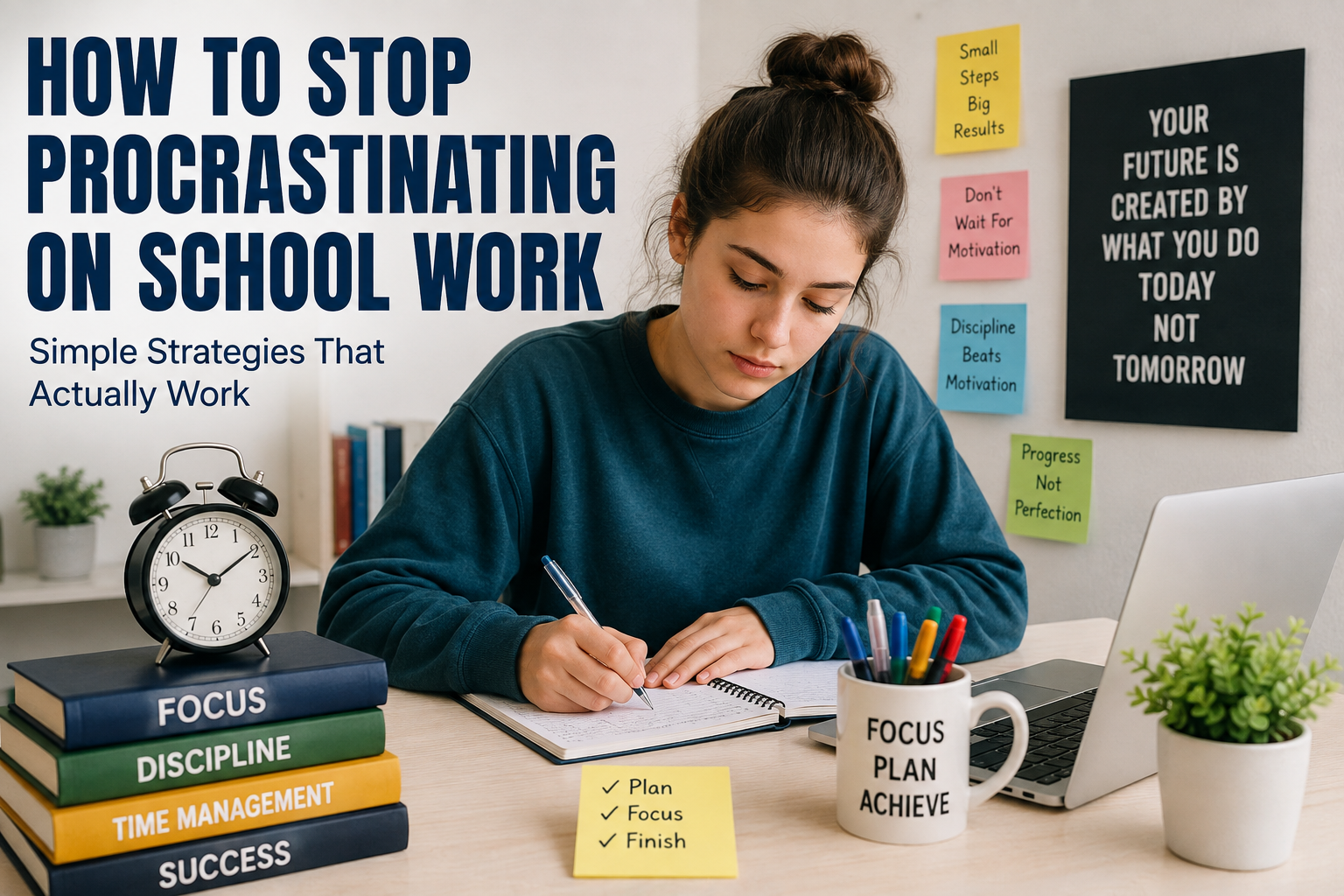
Procrastinating on school work is something many students experience, including students who are usually hardworking and responsible. I believe procrastination is not always about being lazy. Sometimes a school assignment feels too difficult, boring, stressful, or simply too large to handle. When that happens, it becomes easy to say, “I will do it later.” The problem is that later often becomes tomorrow, and tomorrow can quickly become the night before the deadline.
I have learned that the best way to stop procrastinating on school work is not to wait for motivation. Instead, I try to make the work easier to start. Once I begin, I usually find that the task is not as difficult as I imagined.
In this article, I will share practical ways to stop procrastinating on school work, improve focus, manage time, and build better study habits.
Understand Why You Procrastinate
Before trying to fix procrastination, I think it is important to understand why it happens.
Students procrastinate for different reasons. Sometimes an assignment is confusing, so they avoid starting because they do not know what to do. Sometimes the task is boring. Other times, students may be afraid that their work will not be good enough.
Social media, games, television, friends, and mobile phones can also make procrastination easier. A quick look at a notification can turn into thirty minutes of scrolling.
For me, one of the biggest lessons is that procrastination usually becomes worse when a task feels overwhelming. If I have five chapters to study, thinking about all five chapters at once can make me want to avoid studying completely.
That is why breaking large tasks into smaller parts can make such a big difference.
Start With a Very Small Step
One of my favorite ways to stop procrastinating on school work is to make the first step extremely small.
Instead of telling yourself, “I need to finish my entire science project,” try saying, “I will open my notebook and write the title.”
That sounds almost too simple, but it works because starting is often harder than continuing.
Once I write the title, I may add a few notes. Then I may research the first topic. After that, the project starts feeling manageable.
The goal is not to finish everything immediately. The goal is to get moving.
A small beginning can create momentum, and momentum can make school work feel much easier.
Make a Simple Study Schedule
Good time management can help reduce procrastination because you know exactly when you are going to study.
I prefer making a simple study schedule rather than creating a complicated plan that is difficult to follow.
For example, I might decide to study mathematics from 5:00 PM to 5:45 PM, take a short break, and then work on an English assignment.
A schedule gives the work a specific place in my day. Without a plan, I may keep thinking that I have plenty of time. Suddenly, it is late at night and the assignment is still unfinished.
Your study schedule does not have to be perfect. Even planning the next two or three important tasks can make your day more organized.
Break Large Assignments Into Smaller Tasks
Large assignments can easily cause procrastination because they look intimidating.
If I have to write a long essay, I do not think about the entire essay at once. I divide it into smaller tasks.
First, I choose the topic. Then I collect information. After that, I create an outline. Next, I write the introduction and continue with the main sections.
This approach makes the assignment feel like several small jobs instead of one huge job.
The same method works for studying. Instead of saying, “I need to study biology,” choose a specific chapter or topic.
Small goals are easier to understand, easier to start, and easier to complete.
Remove Distractions Before Studying
Distractions are one of the biggest causes of procrastination among students.
If my phone is next to me while I study, I may feel tempted to check messages or social media. Even when I only check my phone for a minute, getting back into deep concentration can take longer than expected.
Before starting school work, I recommend removing unnecessary distractions.
Put your phone somewhere away from your desk. Close websites that are not related to your assignment. Turn off unnecessary notifications and keep your study area clean.
You do not need a perfect study room. You simply need a space where your attention is not constantly being pulled in different directions.
Use a Timer to Stay Focused
Using a timer can make studying feel more manageable.
Instead of telling yourself that you have to study for three hours, start with a shorter period such as twenty five or thirty minutes.
During that time, focus only on your school work. When the timer ends, take a short break.
I like this method because it makes studying feel less exhausting. Knowing that I only need to focus for a limited amount of time makes it easier to begin.
After a few sessions, you may discover that you can concentrate for longer periods.
Do Not Wait for Motivation
One mistake I think many students make is waiting until they feel motivated to study.
Motivation is useful, but it is not always reliable. There will be days when you feel energetic and ready to work. There will also be days when you would rather watch videos, play games, or sleep.
If you only study when you feel motivated, important work can easily be delayed.
Instead, try building a routine. Decide when you will study and start at that time even if you do not feel excited about it.
Often, motivation comes after you begin. Completing one small task can make you feel productive, and that feeling can encourage you to continue.
Set Clear Daily Goals
A vague goal such as “study today” is not very helpful.
A better goal is something specific, such as “complete ten mathematics questions” or “read twenty pages of history.”
Clear goals tell you exactly what needs to be done.
I also recommend keeping your daily goals realistic. If you create a list of twenty tasks and complete only three, you may feel disappointed even though you actually made progress.
A shorter list of important tasks is usually easier to manage.
Reward Yourself After Completing Work
Studying does not have to feel like punishment.
Small rewards can make it easier to stay consistent. After completing an important assignment, you might watch an episode of your favorite show, listen to music, take a walk, or spend some time with friends.
The important thing is to use rewards after making progress rather than using them as a reason to avoid your work.
For example, I might tell myself that after finishing a study session, I can spend some time on my phone.
This creates a simple connection between effort and reward.
Avoid Trying to Be Perfect
Perfectionism can be a hidden cause of procrastination.
Sometimes students delay starting because they want their work to be perfect. They worry about making mistakes or producing something that is not good enough.
I believe it is better to create a rough first version and improve it later.
When writing an essay, for example, I do not need every sentence to be perfect on the first attempt. I can write my ideas first and edit them afterward.
Progress is more useful than waiting for perfection.
Use the Five Minute Rule
When I really do not feel like starting an assignment, I use a simple five minute rule.
I tell myself that I only have to work for five minutes.
During those five minutes, I focus completely on the task. Sometimes I stop after five minutes, but very often I continue because starting was the hardest part.
This technique can be especially useful when you have been avoiding a task for several days.
Five minutes may not seem like much, but five minutes of real work is better than zero minutes.
Study at the Same Time Each Day
Creating a regular study routine can reduce the amount of decision making involved in school work.
If you study at different times every day, you may constantly ask yourself when you should start. A consistent routine removes some of that uncertainty.
For example, you could choose a regular study period after school or after dinner.
Over time, your brain can begin to recognize that period as study time. This can make starting easier.
Do the Most Important Task First
When I have several assignments, I prefer to identify the most important or urgent one first.
This prevents me from spending an entire afternoon on easy tasks while avoiding the assignment that actually needs attention.
Start with the task that has the closest deadline or requires the most concentration.
Once the difficult task is finished, the remaining work often feels much easier.
Be Kind to Yourself After a Bad Day
Everyone procrastinates sometimes.
If you waste an afternoon, do not decide that the entire day is ruined. You can always restart.
Instead of saying, “I already wasted today, so there is no point studying,” try saying, “I can still complete one useful task tonight.”
This change in thinking can make a big difference.
The goal is not to become a student who never procrastinates. The goal is to become better at recognizing procrastination and getting back to work.
Final Thoughts
Learning how to stop procrastinating on school work takes practice. You do not need to completely change your personality or become productive every minute of the day.
Start with simple habits. Break large assignments into smaller tasks. Create a realistic study schedule. Remove distractions. Use a timer. Set clear goals and avoid waiting for motivation.
Most importantly, focus on starting.
When school work feels overwhelming, remind yourself that you do not have to finish everything at once. You only need to take the next step.
In my experience, the hardest part of school work is often opening the book, starting the first question, or writing the first sentence. Once that first step is taken, everything becomes easier.
Procrastination may be a difficult habit to overcome, but it is not impossible. With consistent effort, better time management, and a simple study routine, you can become more focused, organized, and confident in your school work.