
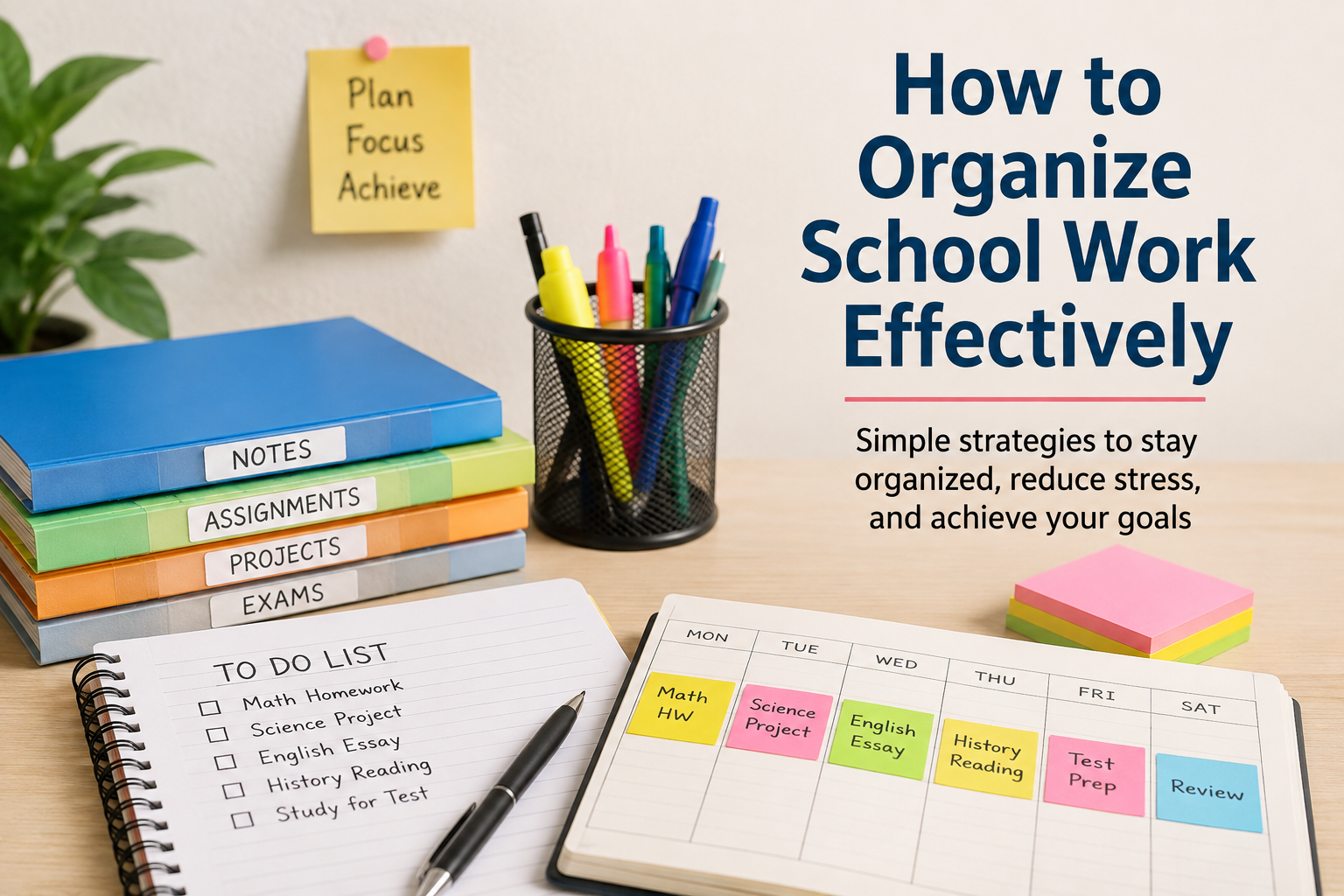
Staying organized at school can make a huge difference in how I study, complete assignments, and manage my time. When school work starts piling up, it is easy to feel stressed or confused about what to do first. I have found that being organized does not mean studying all day or making a complicated schedule. It simply means knowing what I need to do, when I need to do it, and where everything is.
In my experience, a few simple habits can make school work much easier to manage. With the right system, students can complete homework on time, prepare better for exams, and still have enough time for family, friends, hobbies, and rest.
Why Organizing School Work Is Important
The first reason I believe school organization is important is that it reduces unnecessary stress. When I know exactly what assignments I have and when they are due, I do not have to keep worrying about forgetting something.
Good organization also helps me use my time wisely. Instead of spending a long time deciding what to study, I can start working immediately. It also becomes easier to break large projects into smaller tasks.
Another benefit is better academic performance. When school work is organized, I have more time to review lessons, correct mistakes, and prepare for tests. Organization may not automatically improve grades, but it creates better conditions for learning.
Start With a Simple To Do List
One of the easiest ways to organize school work is to create a daily to do list. I prefer keeping my list simple because a long and complicated list can feel overwhelming.
At the beginning of the day or after school, write down everything that needs to be completed. This can include homework, reading, projects, revision, and preparation for the next school day.
After writing everything down, I like to identify the most important tasks. For example, an assignment due tomorrow should usually receive more attention than a project due next week.
A useful to do list might include:
- Complete mathematics homework
- Read the assigned chapter
- Review science notes
- Work on the history project
- Prepare school materials for tomorrow
Checking tasks off the list also gives me a sense of progress and motivation.
Use a School Planner
A school planner can be one of the most useful tools for managing assignments. You can use a paper planner, notebook, calendar, or digital application.
I recommend recording important deadlines as soon as teachers announce them. Do not depend on memory because it is easy to forget an assignment when several subjects have work at the same time.
I like to record the subject, assignment, deadline, and any important instructions. For large projects, I also write down smaller deadlines for different parts of the project.
For example, instead of writing only “Science project due Friday,” I might plan the research on Monday, notes on Tuesday, writing on Wednesday, and final review on Thursday.
This makes a large assignment feel much more manageable.
Keep School Notes Organized
Organizing school notes is another important part of effective school organization. When notes are scattered across different notebooks and papers, studying becomes much harder.
I recommend keeping separate sections for different subjects. Clearly labeling notebooks and folders can save a lot of time.
I also find it helpful to date my notes. This makes it easier to find information when preparing for an exam.
Try to keep notes clear rather than making them unnecessarily complicated. Important definitions, formulas, examples, and key ideas should be easy to find.
If you use digital notes, create separate folders for each subject. Give files clear names so you can find them quickly.
Organize Your School Bag
A messy school bag can make every school day more difficult. I have found that spending a few minutes organizing my bag can save much more time later.
At the end of the school day, remove unnecessary papers, empty food wrappers, and items that are not needed. Then check your schedule and pack the books and materials required for the next day.
Keep important items in the same place. For example, stationery can stay in one pencil case while assignments can stay in a specific folder.
This simple habit can prevent the common problem of arriving at school and realizing that an important notebook or assignment was left at home.
Break Large Assignments Into Smaller Tasks
Large projects often look difficult because they contain many different tasks. Instead of trying to finish everything at once, I prefer dividing the work into smaller steps.
For example, if I have to write a research project, I might divide it into choosing a topic, finding information, creating an outline, writing the first draft, editing the work, and preparing the final version.
Each small task feels easier to complete than one huge assignment.
This method also helps prevent procrastination. When the next step is clear, it becomes easier to start.
Set Priorities
Not every school task has the same level of importance. Learning how to prioritize is therefore an important part of organizing school work effectively.
I usually consider three things when deciding what to do first: the deadline, the amount of work required, and the importance of the assignment.
A test tomorrow should probably receive more attention than a reading assignment due next week. However, if the longer assignment requires several hours, it is still smart to start early.
Prioritizing does not mean ignoring smaller tasks. It simply helps you decide where your attention should go first.
Create a Study Schedule
A realistic study schedule can help students stay consistent. I do not think a schedule needs to be complicated. Even a simple plan can work well.
For example, after school, you might spend thirty minutes reviewing mathematics, take a short break, then work on English homework for forty minutes.
The important thing is to create a schedule that matches your actual routine. If you make a schedule that is too difficult to follow, you may quickly stop using it.
Leave some free time between study sessions. Breaks can help you return to your work with better concentration.
Keep Your Study Space Clean
Your study environment can affect your ability to focus. A desk covered with books, papers, food, and random objects can become distracting.
I prefer keeping only the materials I need for the current task on my desk. Everything else can be placed in a drawer, folder, or shelf.
Good lighting and a comfortable chair can also make studying more pleasant.
The goal is not to create a perfect study room. The goal is simply to create a space where you can concentrate without unnecessary distractions.
Avoid Multitasking
Many students believe they can save time by doing several things at once. In reality, switching between homework, social media, videos, and messages can make it harder to concentrate.
When I need to complete an important assignment, I try to focus on one task at a time. I put away unnecessary distractions and give the assignment my full attention.
After completing the task, I can take a break and check other things.
Focused work is often more effective than spending a long time constantly switching between activities.
Review Your Work Before the Deadline
One habit that I strongly recommend is finishing school work before the final deadline whenever possible.
If an assignment is due Friday, try to finish it Thursday or earlier. This gives you time to check grammar, spelling, calculations, formatting, and instructions.
Leaving everything until the last minute creates unnecessary pressure. It also increases the chance of making avoidable mistakes.
A short review can make a big difference in the quality of your work.
Prepare for the Next School Day
Before going to bed, take a few minutes to prepare for tomorrow. Check your schedule, organize your school bag, and make sure important assignments are ready.
I find this small habit especially useful because it makes the morning less stressful. Instead of rushing around looking for books and homework, everything is already prepared.
This can also help you start the school day with a more positive mindset.
Do Not Forget About Rest
Being organized does not mean filling every minute with school work. Rest is also an important part of being productive.
Students need enough sleep, regular breaks, physical activity, and time to relax. If you constantly study without taking care of yourself, concentration can become more difficult.
I believe the best school organization system is one that creates balance. Make time for your responsibilities, but also make time for yourself.
Final Thoughts
Learning how to organize school work effectively does not require expensive tools or a complicated productivity system. Simple habits can make a noticeable difference.
Start with a daily to do list, use a school planner, organize your notes, keep your school bag clean, and divide large assignments into smaller tasks. Set priorities and create a realistic study schedule. Most importantly, avoid leaving everything until the last minute.
From my point of view, organization is something that improves with practice. You do not have to become perfectly organized overnight. Start with one or two habits and gradually build a routine that works for you.
When school work is organized, studying can feel less stressful and more manageable. You have a clearer idea of what needs to be done, more control over your time, and a better opportunity to focus on learning. With consistency and a simple system, organizing school work can become a natural part of your daily routine.