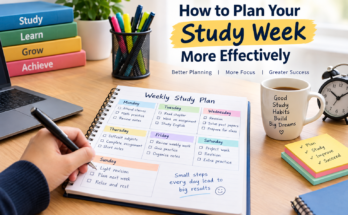

Studying for a long time does not always mean that you are learning more. I have noticed that one of the biggest problems students face is not a lack of time but the way they use their available time. A study session can easily turn into checking a phone, watching random videos, organizing notes again and again, or simply sitting with a book without actually learning anything.
If you want to improve your study routine, learning how to avoid wasting time while studying can make a big difference. In my opinion, effective studying is more about focus, planning, and consistency than spending endless hours at a desk.
In this article, I will share some simple and practical study tips that can help students manage their time, stay focused, and get more work done without feeling overwhelmed.
Set a Clear Study Goal
One of the easiest ways to waste study time is to start studying without knowing exactly what you want to accomplish. When I sit down with a general goal like “I need to study today,” it is easy to become distracted.
Instead, create a specific goal before starting.
For example, you can decide to complete one chapter, revise twenty vocabulary words, solve fifteen mathematics questions, or prepare a particular topic for an upcoming test.
A clear goal gives your study session direction. It also makes it easier to know when the session is complete.
Create a Simple Study Plan
A study plan does not need to be complicated. In fact, I believe a simple plan is often easier to follow.
Before starting your day, write down the subjects or tasks you need to complete. Put the most important tasks first. Then decide approximately how much time you want to give each task.
For example, your plan could look like this:
Study mathematics for 45 minutes
Take a short break
Read one science chapter for 40 minutes
Review history notes for 30 minutes
Complete homework for 45 minutes
This simple structure can prevent you from spending too much time on one activity while ignoring everything else.
Keep Your Phone Away
For many students, the phone is one of the biggest sources of wasted study time. A notification can quickly turn into ten or twenty minutes of scrolling.
When I need to concentrate, I prefer keeping my phone away from my study area. If you need your phone for educational purposes, turn off unnecessary notifications and use only the apps you need.
You can also put your phone on silent mode or activate a focus mode.
The goal is not to completely avoid technology. The goal is to make sure technology supports your studying instead of controlling your attention.
Avoid Multitasking
Many students believe they can study while chatting with friends, watching videos, listening to unrelated content, and checking social media. In my experience, this usually makes studying slower.
When your attention keeps moving between different activities, it becomes harder to understand and remember information.
Try focusing on one task at a time. If you are studying biology, focus on biology. When you finish that task, move to the next one.
Single tasking can make your study sessions much more productive.
Use a Timer
Using a study timer is a simple way to improve time management. You can choose a specific amount of time and work only on your planned task during that period.
For example, you might study for 30 minutes and then take a five minute break. You can repeat the process several times.
The exact timing is not important for everyone. Some students prefer shorter sessions, while others can concentrate for longer periods.
What matters is having a clear beginning and ending for your study session.
Take Useful Breaks
Taking breaks does not mean that you are wasting time. A good break can actually help you return to your work with better concentration.
The important thing is to control your breaks.
Instead of opening social media and scrolling without a limit, try taking a short walk, drinking water, stretching, or simply resting your eyes.
I find that planned breaks are much better than unplanned distractions because you already know when you will return to studying.
Do Not Spend Too Much Time Making Notes
Making notes can be helpful, but it can also become a way of avoiding real studying.
Some students spend hours making beautiful notes without spending enough time understanding the subject.
Your notes do not need to look perfect. They need to be useful.
Focus on important ideas, definitions, examples, formulas, and information that you may need to remember later.
After making notes, spend time reviewing them and testing yourself. Understanding the material is more important than creating perfect pages.
Start With Difficult Tasks
Another useful study habit is to work on difficult tasks when your concentration is strongest.
For example, if mathematics requires more mental effort than reading, you may want to study mathematics earlier in your study schedule.
Leaving difficult work until you are already tired can make it feel even harder.
Of course, every student has a different routine. Pay attention to the time of day when you feel most alert and use that time for challenging subjects.
Make Your Study Area Simple
Your environment can have a major effect on your concentration. A messy desk can create unnecessary distractions.
Before studying, remove things that you do not need. Keep your books, notebook, pen, water, and other essential materials nearby.
You do not need an expensive study room. A simple and comfortable place can work very well.
The main purpose is to create an environment that tells your brain it is time to focus.
Stop Repeatedly Checking Your Progress
It is good to know how much work you have completed, but checking your progress every few minutes can interrupt your concentration.
For example, if you study for ten minutes and then keep looking at the clock, you may spend more time thinking about time than actually studying.
Set a reasonable target and focus on the task. Check your progress after completing a meaningful section of work.
Use Active Learning
Reading the same page several times may feel productive, but it does not always lead to strong learning.
I prefer active learning methods because they require you to interact with the information.
You can ask yourself questions, explain a topic in your own words, solve practice questions, create flashcards, or try to recall information without looking at your book.
For example, after reading a science topic, close the book and explain the main idea from memory. If you cannot explain it, return to the material and review it.
This approach can make study time more useful.

Avoid Perfectionism
Perfectionism can quietly waste a lot of study time. Students sometimes spend too long trying to make every note, assignment, or answer perfect.
There is a difference between doing quality work and spending unnecessary time on small details.
Give yourself a reasonable amount of time for each task. Complete the important parts first, then improve your work if extra time is available.
Progress is usually more valuable than perfection.
Prepare Your Materials Before Studying
Another simple way to save time is to prepare everything before your study session begins.
Collect the books, notebooks, pens, calculator, laptop, or other materials you need.
If you keep getting up to search for something, your concentration can break. Having everything ready allows you to start working immediately.
This small habit can save more time than you might expect.
Learn to Say No to Distractions
Friends, family members, notifications, entertainment, and household activities can all interrupt your study routine.
If you have an important study session, let people around you know that you need some quiet time.
You do not have to ignore everyone all day. Simply create a specific period when you want to focus.
Once the study session is finished, you can return to other activities.
Review What You Accomplished
At the end of your study session, take a few minutes to review what you completed.
Ask yourself:
What did I learn?
What tasks did I complete?
What do I still need to study?
What distracted me today?
What can I improve tomorrow?
This quick review can help you identify patterns in your study habits. If you notice that you always waste time on your phone, you can make changes to your environment. If a particular subject takes longer than expected, you can adjust your future study plan.
Final Thoughts
Learning how to avoid wasting time while studying is not about studying every minute of the day. It is about making the time you already have more useful.
From my point of view, the most important habits are setting clear goals, creating a simple study plan, keeping distractions away, avoiding multitasking, taking controlled breaks, and using active learning techniques.
You do not need to change everything at once. Start with one or two habits and practice them consistently. Once they become natural, add another habit to your routine.
Good time management is a skill that improves with practice. The more aware you become of how you spend your study time, the easier it becomes to identify distractions and stay focused on what actually matters.
Remember, successful studying is not about sitting at a desk for the longest possible time. It is about using your attention wisely and making every study session count.