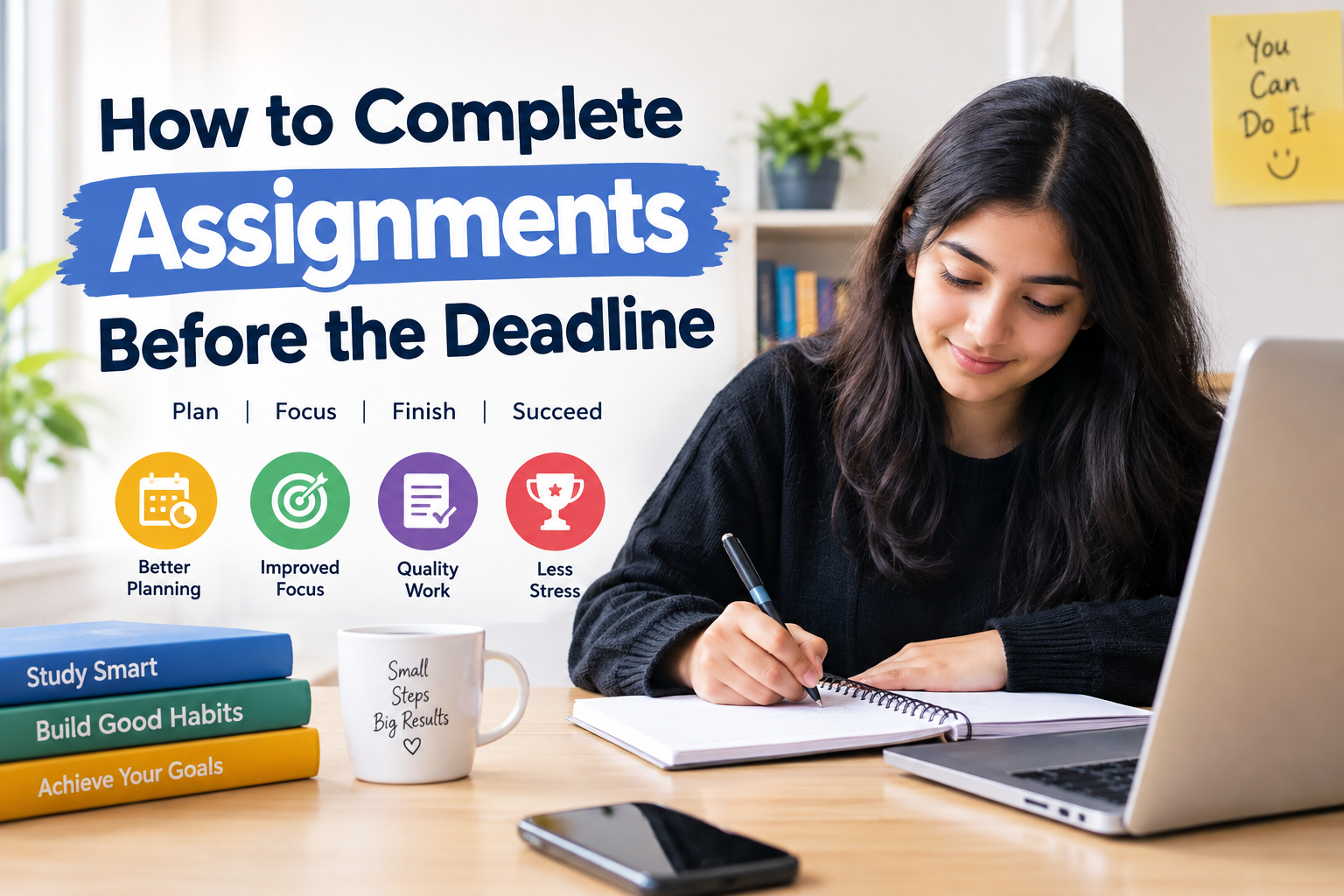
Completing assignments before the deadline is one of the most useful habits a student can develop. In my experience, the biggest problem is not always that students have too much work. Sometimes the real problem is poor planning, distractions, or waiting until the last moment to begin. When an assignment is left until the deadline is close, even a simple task can feel stressful.
I believe completing assignments on time becomes much easier when you have a simple system. You do not need to study for many hours every day. You need to understand what has to be done, divide the work into smaller tasks, and give yourself enough time to complete everything properly.
In this article, I will share practical ways to complete assignments before the deadline and avoid last minute pressure.
Understand the Assignment First
Before starting an assignment, I always recommend understanding exactly what the teacher is asking for. Many students start writing immediately without reading the instructions carefully. This can create problems later because they may misunderstand the topic or miss an important requirement.
Read the assignment instructions slowly. Identify the topic, word count, format, research requirements, submission method, and deadline. If there are questions that you do not understand, try to clarify them before doing most of the work.
Understanding the assignment first gives you a clear direction. It also helps you estimate how much time you actually need.
Write Down the Deadline
One simple habit that can make a big difference is writing down every assignment deadline. You can use a notebook, calendar, planner, or digital task management app.
Do not depend only on your memory. When you have several subjects, it is easy to forget an assignment.
I prefer keeping all deadlines in one place. This allows me to see which assignments are coming soon and which ones can wait for another day. You can also set a reminder a few days before the actual deadline.
The goal is to know about the deadline before it becomes urgent.
Break the Assignment Into Small Tasks
A large assignment can look difficult when you think about it as one big task. Instead, divide it into smaller steps.
For example, if you have to write a research assignment, your tasks could include choosing a topic, collecting information, creating an outline, writing the introduction, writing the main sections, preparing the conclusion, checking references, proofreading, and submitting the final work.
Each individual task feels much easier than the entire assignment.
This is one of my favorite methods for avoiding procrastination. Instead of thinking, “I have to finish my whole assignment,” think, “Today I only need to complete the outline.”
Small progress eventually becomes a completed assignment.
Start Earlier Than You Think
If an assignment is due Friday, do not make Thursday your starting day. Starting early gives you extra time if something unexpected happens.
You may become busy with another subject, have difficulty understanding a topic, or discover that your research needs more time than expected. When you start early, these problems are easier to handle.
I believe starting early is more important than trying to work extremely fast. A little progress every day can be much better than several stressful hours the night before submission.
Create a Simple Study Schedule
A study schedule can help you decide when you will work on each assignment. Your schedule does not need to be complicated.
For example, you might spend thirty minutes researching on Monday, forty minutes creating an outline on Tuesday, one hour writing on Wednesday, and thirty minutes proofreading on Thursday.
The exact schedule depends on your workload and the size of the assignment.
Try to choose realistic study periods. If you know that you cannot concentrate for three hours after school, do not create a schedule that requires three hours. A realistic schedule is easier to follow.
Set Your Own Earlier Deadline
One useful strategy is to create a personal deadline that is earlier than the teacher’s deadline.
If your actual deadline is Friday, you might decide that your personal deadline is Wednesday evening. This gives you a safety period.
Finishing early also gives you time to review your work. You may notice spelling mistakes, missing information, weak explanations, or formatting problems that you would not have time to fix if you waited until the last minute.
An earlier personal deadline can turn a stressful situation into a manageable one.
Remove Distractions While Studying
Distractions are one of the biggest reasons students waste time while completing assignments. Phones, social media, games, videos, and unnecessary notifications can easily interrupt your concentration.
When I need to focus on an assignment, I try to keep my phone away from my study area or turn off unnecessary notifications.
Your study environment also matters. A clean desk, comfortable chair, good lighting, and necessary study materials can make it easier to concentrate.
You do not need a perfect study room. You simply need a place where you can focus without constantly checking something else.
Use Focused Study Sessions
You do not always need long study sessions to complete assignments. Focused sessions can be very effective.
Try working for a specific amount of time, such as twenty five or thirty minutes. During that period, focus only on the assignment. Then take a short break before continuing.
During your focused session, avoid switching between different tasks. If you are writing, focus on writing. If you are researching, focus on research.
This approach can help you make meaningful progress without feeling mentally exhausted.
Prioritize Difficult Assignments
When you have several assignments, decide which ones need attention first. A useful approach is to consider both the deadline and the amount of work required.
An assignment due tomorrow should obviously receive attention, but a large project due next week may also need to be started early.
I like to look at my complete workload instead of focusing only on today’s task. This helps prevent situations where several large assignments become urgent at the same time.
Avoid Trying to Make Everything Perfect
Students sometimes delay assignments because they want their first attempt to be perfect. This can make starting much harder.
When writing, focus first on getting your ideas onto the page. You can improve sentences, correct mistakes, and reorganize information during the editing stage.
Trying to create a perfect first draft can slow you down unnecessarily.
A better approach is to create a complete first version and then improve it.
Keep Track of Your Progress
Tracking progress can make assignments feel more manageable. You can use a simple checklist.
For example:
Research completed
Outline completed
Introduction completed
Main sections completed
Conclusion completed
References checked
Proofreading completed
Assignment submitted
Checking off completed tasks gives you a clear picture of your progress.
It also helps you identify what still needs to be done instead of feeling like the entire assignment is unfinished.
Ask for Help When You Need It
Sometimes an assignment takes longer because you are stuck on one part. Instead of spending hours going around the same problem, ask for appropriate help.
You can ask your teacher for clarification, discuss the topic with a classmate, use reliable educational resources, or review your course materials.
Asking for help does not mean you are unable to complete the assignment. It can simply help you understand something faster and continue working.
Leave Time for Proofreading
Never plan to finish an assignment at the exact deadline. Leave some time for checking your work.
Proofreading can help you find spelling mistakes, grammar problems, missing words, incorrect information, and formatting issues.
Read your assignment once after completing it. If possible, take a short break before proofreading. Looking at the work again after some time can make mistakes easier to notice.
Also check whether you have followed the teacher’s instructions before submitting.
Submit Before the Deadline
Once your assignment is complete and checked, submit it as soon as you reasonably can. Do not keep a finished assignment waiting until the final minute.
Technical problems can happen. Your internet connection may stop working, the submission website may have an issue, or you may discover a file problem.
Submitting early gives you a little protection against unexpected problems.
Final Thoughts
Learning how to complete assignments before the deadline is mainly about building better habits. You do not have to become extremely strict with yourself or study all day. Start by understanding the assignment, writing down the deadline, breaking the work into smaller tasks, and creating a realistic schedule.
Avoid distractions and focus on one task at a time. Start earlier, track your progress, ask for help when necessary, and leave enough time for proofreading and submission.
In my view, the biggest change comes when you stop seeing an assignment as one huge task. Divide it into small steps and complete those steps consistently. With practice, finishing assignments before the deadline can become a normal part of your study routine.
The result is not only better time management. You can also reduce last minute stress, improve the quality of your work, and have more free time after your school or college responsibilities are finished.