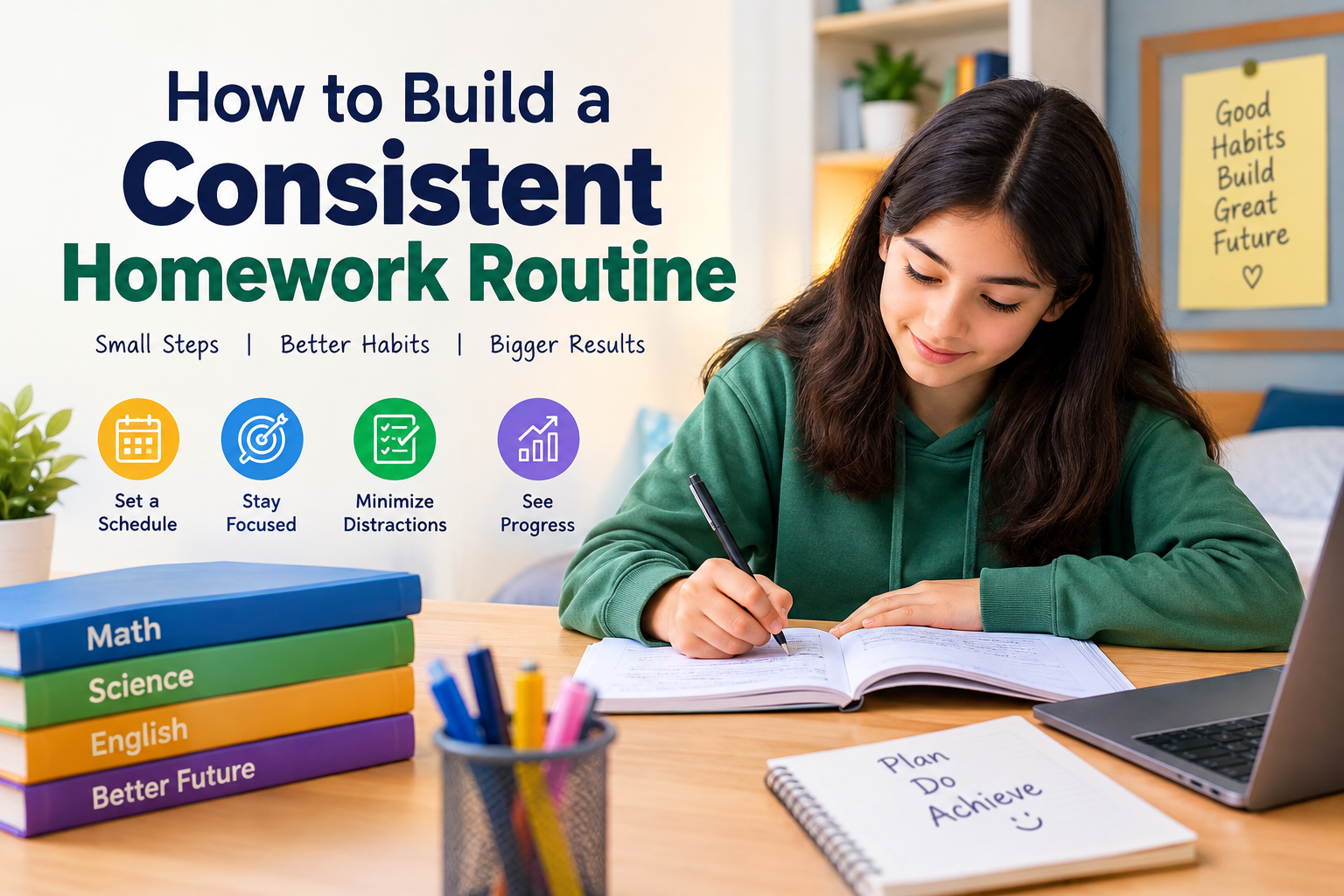
Building a consistent homework routine can make school life much easier. In my experience, homework becomes stressful when we keep delaying it, work without a plan, or try to finish everything at the last minute. A simple routine can help students stay organized, complete assignments on time, and still have enough time for rest and other activities.
The good thing is that you do not need a complicated system to create a homework routine. You mainly need a suitable time, a comfortable study space, clear priorities, and the commitment to follow your routine regularly. Once these habits become part of your daily life, homework can feel more manageable.
Why a Consistent Homework Routine Matters
A consistent homework routine gives your day some structure. When you know exactly when and where you will do your homework, you spend less time deciding when to start.
Without a routine, it is easy to say, “I will do it later.” Later can quickly become evening, and suddenly there is not enough time to complete everything properly.
A regular homework schedule can also reduce stress. Instead of thinking about unfinished assignments throughout the day, you have a specific period reserved for schoolwork. This can help you focus better because your mind knows that homework has its own place in your daily schedule.
Another benefit is better time management. Students who regularly plan their homework can learn how to estimate how long different tasks will take. This skill can become useful not only in school but also in college, work, and everyday life.
Choose a Homework Time That Works for You
The first step in building a homework routine is choosing a regular homework time. There is no single perfect time for every student.
Some students concentrate better immediately after returning home. Others need time to eat, relax, or take a short break before studying. I believe the best homework time is the period when you can usually concentrate without feeling extremely tired.
For example, you might decide to start homework at 5:00 PM every weekday. Another student may prefer 7:00 PM. The exact time matters less than having a predictable schedule.
Try to consider your other responsibilities. If you have sports practice, family responsibilities, or other activities, choose a homework period that fits naturally into your day.
Create a Simple Study Space
Your environment can have a major effect on your homework routine. A good study space does not need to be expensive or fancy. It simply needs to be comfortable, organized, and suitable for concentration.
Choose a place where you can sit properly and keep your books and school supplies nearby. Before starting homework, remove unnecessary items from the desk.
Try to reduce distractions as much as possible. Put your phone away if you do not need it for your assignment. Turn off unnecessary notifications and avoid opening social media while studying.
When your study area is ready, starting homework can become easier because you do not have to spend several minutes preparing everything.
Make a Homework Checklist
One of the easiest ways to organize homework is to create a simple checklist.
At the beginning of your homework period, write down everything you need to complete. For example, your list might include mathematics exercises, a science reading assignment, an English essay, and preparation for a quiz.
Once everything is written down, you can decide what needs attention first.
I find that a checklist makes homework feel less confusing. Instead of keeping several tasks in your head, you can see everything clearly in front of you. Completing each task also gives you a sense of progress.
Keep the checklist realistic. Do not fill it with too many unnecessary tasks. Focus on the schoolwork that actually needs to be completed.
Prioritize Important Assignments
Not every homework task has the same level of urgency. Some assignments may be due tomorrow, while others are due several days later.
Start by checking deadlines. Then consider how difficult each task is likely to be.
If you have a difficult mathematics assignment due tomorrow, it may deserve more attention than a simple reading task due next week.
A useful approach is to complete urgent and important work first. However, if a difficult assignment requires a lot of mental energy, you may want to work on it while you are still feeling fresh.
Learning how to prioritize homework can prevent last minute pressure and help you use your study time more effectively.
Break Large Assignments Into Smaller Tasks
Large assignments can sometimes feel overwhelming. Looking at a long project as one huge task may make you want to avoid starting it.
Instead, divide the assignment into smaller steps.
For example, if you need to write a school report, you could divide it into choosing a topic, researching information, creating an outline, writing the first draft, reviewing the draft, and preparing the final version.
Each small step feels easier to handle than the entire project.
This method is especially useful for students who struggle with procrastination. Starting with a small task can help you build momentum and make the rest of the work feel more manageable.
Use Short Study Sessions
You do not always need to study for several hours without stopping. Long sessions can sometimes lead to tiredness and reduced concentration.
Try working in focused study sessions with short breaks. For example, you could work for 30 to 45 minutes and then take a short break.
During the focused period, try to give your full attention to homework. During the break, stand up, drink water, stretch, or simply rest your mind.
The goal is not to make every homework session extremely long. The goal is to make the time you have more productive.
Start With the Right Mindset
Starting is often harder than continuing. When you look at several assignments at once, you may feel like there is too much to do.
Instead of thinking, “I have so much homework,” focus on the first task.
Tell yourself that you only need to begin. Open the book, read the question, or write the first sentence. Once you start, the task often feels easier.
I believe this small mental change can make a big difference. You do not have to feel motivated before starting. Sometimes motivation comes after you begin making progress.
Keep Your Homework Routine Flexible
A consistent homework routine does not mean every day has to be exactly the same.
Unexpected things can happen. You may have a family event, an appointment, a school activity, or a particularly difficult assignment.
If your normal routine does not work on one day, adjust it instead of abandoning it completely.
For example, if you normally study from 5:00 PM to 6:30 PM but have an activity that day, you could study for an hour later in the evening.
The important thing is to return to your normal routine afterward. Missing one study session does not mean your entire routine has failed.
Avoid Multitasking
Multitasking can make homework take longer. If you are trying to study while constantly checking messages, watching videos, and browsing social media, your attention keeps moving between different activities.
Try to focus on one homework task at a time.
If you need your computer for schoolwork, keep unrelated websites and applications closed. If you need your phone for research, use it only for the task.
A focused homework session can often be more productive than a much longer session filled with distractions.
Prepare for Tomorrow
A good homework routine should include a few minutes of preparation for the next school day.
After finishing your assignments, check your school schedule and make sure everything is ready. Put completed homework where you can easily find it. Pack the books and supplies you will need.
This simple habit can save time in the morning and reduce the chance of forgetting an assignment.
It can also give you a feeling of completion. Once everything is prepared, you can relax without constantly wondering whether something has been forgotten.
Reward Your Progress
Homework should not feel like an endless cycle of work. After completing your important assignments, give yourself time to enjoy something you like.
You could listen to music, spend time with family, play a game, read for fun, or watch a favorite program.
The reward does not need to be large. The purpose is to create a healthy balance between responsibility and free time.
When students know that enjoyable activities are waiting after their homework, it can become easier to stay focused during study time.
Review Your Routine Every Week
Your homework routine may not be perfect from the beginning. Give yourself time to discover what works.
At the end of each week, think about your study habits. Ask yourself whether you started homework on time, whether your study space helped you concentrate, and whether you had enough time for difficult assignments.
If something did not work, make a small adjustment.
Maybe you need to start earlier. Maybe you need longer breaks. Maybe your phone is creating too many distractions.
Small improvements can gradually create a much stronger homework routine.
Final Thoughts
Building a consistent homework routine is mainly about creating simple habits and repeating them. You do not need a complicated planner or a perfect schedule. Start by choosing a regular homework time, preparing a useful study space, making a checklist, and deciding which assignments deserve your attention first.
Break large tasks into smaller steps and take short breaks when necessary. Keep distractions under control and remember that your routine can be flexible when unexpected situations happen.
In my view, consistency is more important than perfection. You may have an unproductive day sometimes, and that is completely normal. What matters is getting back to your routine and continuing.
When you build a homework routine that fits your daily life, schoolwork can become more organized and less stressful. Over time, these simple habits can improve your time management, concentration, responsibility, and confidence. The goal is not just to finish homework. The goal is to develop study habits that can help you become a more organized and independent student.