
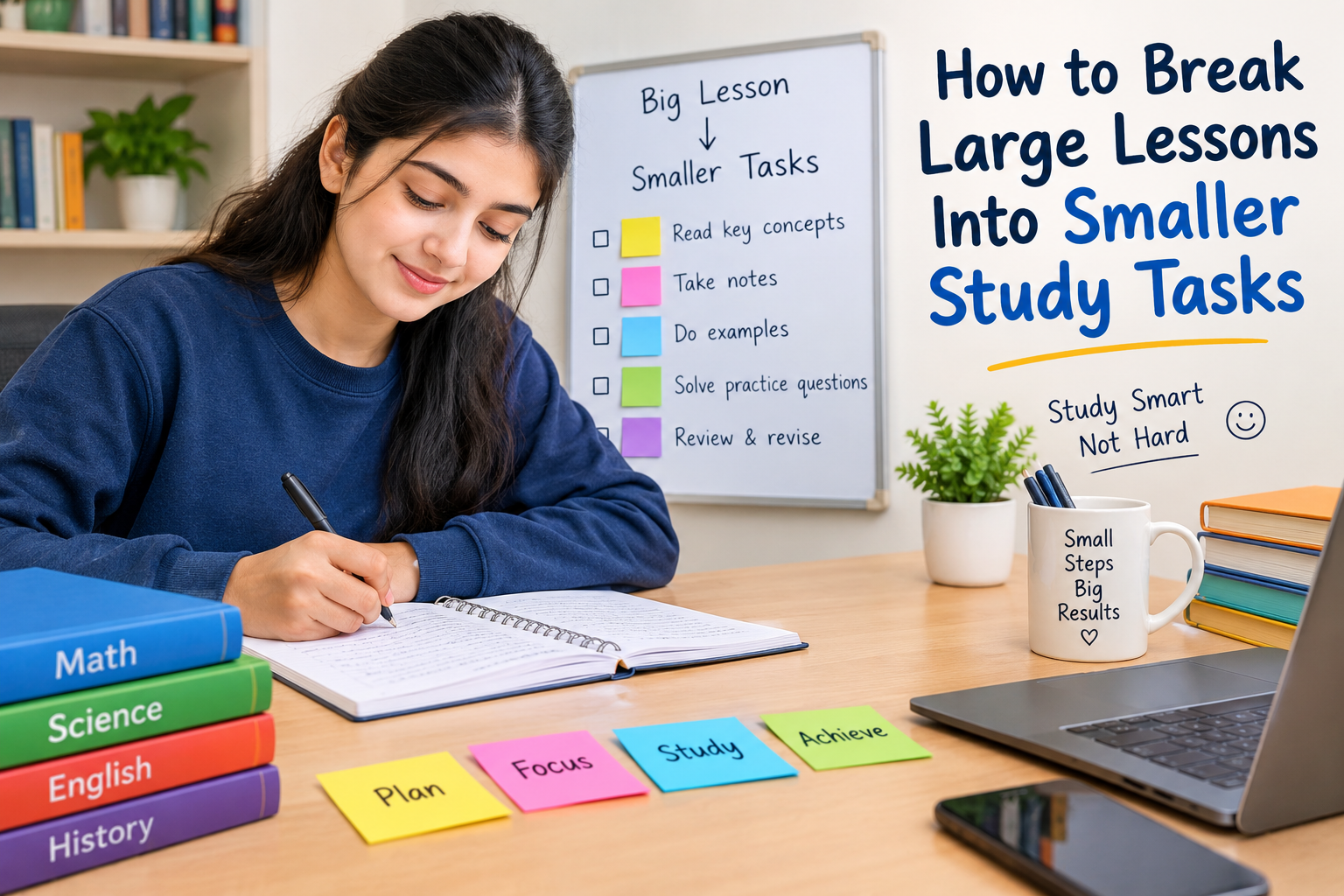
Studying a large lesson can sometimes feel overwhelming, especially when there are many pages, difficult concepts, definitions, examples, and questions to understand. When I look at a big lesson as one complete task, it can feel difficult to know where to begin. However, when I break large lessons into smaller study tasks, the entire learning process becomes much easier and more manageable.
In my experience, the best way to study effectively is not always to spend more hours with a book. It is about knowing how to organize those hours. Breaking a large lesson into smaller parts helps me stay focused, understand information better, and feel more confident about my progress.
Why Breaking Large Lessons Into Smaller Tasks Helps
A large lesson can create unnecessary pressure because the brain sees it as one big responsibility. For example, if a science chapter has thirty pages, thinking about completing the entire chapter in one sitting can make studying feel exhausting before you even begin.
Instead, I prefer to divide the lesson into smaller sections. I might read five pages, understand the main ideas, write short notes, and then take a small break. After that, I continue with the next section.
This approach makes studying feel achievable. Every completed task gives me a sense of progress. It also becomes easier to identify which topics I understand and which areas need more attention.
Start by Understanding the Entire Lesson
Before dividing a lesson, I first look at the complete chapter. I check the title, headings, subheadings, diagrams, examples, important terms, questions, and summary.
This first look does not mean that I am trying to memorize everything. My goal is simply to understand the structure of the lesson.
For example, a history chapter may contain several important events, while a mathematics chapter may include different formulas and problem types. Once I understand the structure, I can divide the lesson according to its natural sections.
This simple step can make study planning much easier.
Divide the Lesson Into Main Sections
The next step is to divide the large lesson into major topics. I usually use headings and subheadings as a guide because textbooks are often already organized into logical sections.
Suppose a biology lesson contains five major topics. Instead of writing one task called “Study Biology Chapter,” I create five smaller tasks.
Read the first topic.
Understand the main concepts.
Write important notes.
Study the second topic.
Practice related questions.
Review the difficult areas.
These tasks feel much easier than one large instruction to complete an entire chapter.
Break Each Section Into Specific Actions
Simply dividing a chapter into sections may not be enough. I also like to divide each section into specific actions.
For example, instead of writing “Study Chapter 4,” I can create tasks such as:
Read pages one to five.
Highlight important concepts.
Write five key points.
Learn important definitions.
Review the diagram.
Answer practice questions.
Explain the topic in my own words.
This makes my study plan clear. When I sit down to study, I do not waste time wondering what I should do next.
Set Small Study Goals
Small study goals are one of the most useful ways to stay motivated. A goal should be specific and realistic.
Instead of saying, “I will study mathematics today,” I might say, “I will understand two formulas and solve ten practice questions.”
The second goal gives me a clear target. Once I complete it, I know exactly what I have achieved.
Small goals also help prevent procrastination. When a task looks easy to start, I am more likely to begin immediately instead of delaying it.
Use the Page Count Carefully
Page numbers can be helpful when breaking large lessons into smaller study tasks. However, I do not always divide a lesson into equal numbers of pages.
Some pages may contain simple information that I can understand quickly. Other pages may contain complicated concepts that require more time.
For this reason, I prefer dividing lessons according to difficulty and content rather than only page numbers.
For example, I might study three easy pages in one session but spend an entire session understanding one difficult concept. This is completely normal. The purpose is understanding, not simply finishing pages.
Give Difficult Topics Extra Time
Not every part of a lesson requires the same amount of effort. Some topics are easy to understand, while others require repeated reading and practice.
When I find a difficult topic, I do not try to rush through it just to finish my study schedule. Instead, I break that topic into even smaller tasks.
First, I read the explanation.
Then I identify unfamiliar words.
Next, I look at the examples.
After that, I explain the concept in simple words.
Finally, I solve related questions.
This method turns a difficult concept into several manageable activities.
Use Time Based Study Sessions
Another useful technique is dividing study time into short sessions. Studying for several hours without a proper break can reduce concentration.
I prefer setting a realistic amount of time for each task. For example, I might spend twenty five minutes reading and understanding a section, followed by a short break. Then I continue with another task.
The exact study time depends on the student and the difficulty of the subject. The important point is to avoid making every study session feel endless.
Short and focused sessions can make large lessons feel much more manageable.
Create a Simple Checklist
A checklist can make studying more satisfying because it allows me to see progress.
For a large lesson, my checklist might look like this:
Read the introduction.
Understand the first main topic.
Write short notes.
Study the second topic.
Review important definitions.
Practice questions.
Review difficult concepts.
Complete final revision.
Every time I complete a task, I can mark it as finished. Seeing several completed tasks gives me motivation to continue.
Take Notes in Small Sections
Taking notes for an entire chapter at once can become tiring. I find it more effective to take notes after completing each small section.
My notes usually include important definitions, key ideas, formulas, examples, and questions that I need to review later.
I try not to copy every sentence from the textbook. Instead, I write information in my own words.
This also helps with understanding because I have to think about what the lesson is actually saying.
Use Active Recall After Each Task
After completing a small study task, I like to test myself instead of immediately moving forward.
I close the book and ask myself questions such as:
What did I just learn?
Can I explain this concept without looking at my notes?
What are the most important points?
Which part was difficult?
Can I give an example?
This method helps me discover whether I actually understood the material or simply read it.
Active recall is especially useful when studying large lessons because it prevents false confidence.
Connect Small Tasks Together
Breaking a lesson into small tasks does not mean studying every part separately forever. After completing the smaller sections, I connect them together.
For example, after studying several sections of a science chapter, I review how the concepts relate to each other.
This helps me understand the lesson as a complete topic rather than a collection of disconnected facts.
I may create a short summary, concept map, or list of key ideas to see the bigger picture.
Leave Time for Revision
One mistake I try to avoid is spending all my study time learning new material and leaving no time for revision.
When I divide a large lesson into smaller tasks, I always include revision as part of the plan.
For example, after completing three sections, I can spend ten minutes reviewing them. At the end of the lesson, I can do a complete review.
Regular revision helps strengthen memory and makes future study sessions easier.
Do Not Try to Finish Everything in One Day
When I have a large lesson, I remind myself that completing everything in one sitting is not always the best approach.
If the lesson is particularly long or difficult, I can spread the tasks across several days.
For example, I might study two sections today, two tomorrow, and the remaining sections the following day. Then I can reserve another session for revision and practice.
This approach reduces stress and gives my brain more opportunities to process the information.
Track Your Progress
Progress tracking can make a major difference in motivation. I like to record which tasks I have completed and which ones still need attention.
A simple study planner can include the lesson name, smaller tasks, completion status, and revision date.
This also helps me avoid studying the same easy topics repeatedly while ignoring difficult ones.
When I can clearly see my progress, a large lesson no longer feels impossible.
Adjust Your Study Plan When Necessary
A study plan should guide me, not control me. Sometimes a task takes longer than expected. Sometimes I understand a topic faster than planned.
When this happens, I adjust the schedule.
If one topic requires additional practice, I give it more time. If another topic is already familiar, I can move through it faster.
Flexibility is important because effective studying is about learning, not simply following a timetable.
Make Smaller Tasks Specific and Realistic
One of the biggest lessons I have learned is that small tasks should be clear. A task such as “study chapter” is too broad.
A better task would be “read pages ten to fifteen and write five key points.”
The second task tells me exactly what I need to accomplish. It is easier to start, easier to measure, and easier to complete.
I also avoid creating too many tasks at once. If my study plan contains twenty small tasks for one afternoon, it can become overwhelming again. I prefer a realistic number of tasks that I can actually complete.
Final Thoughts
Learning how to break large lessons into smaller study tasks can make studying less stressful and more productive. Instead of looking at a large chapter as one difficult responsibility, I can divide it into sections, specific actions, short study sessions, practice activities, and revision tasks.
From my point of view, the biggest advantage is that small tasks create visible progress. Every completed section brings me closer to completing the entire lesson.
The most important thing is to focus on understanding rather than simply finishing pages. I can read a section, take useful notes, test myself, practice questions, and review difficult areas before moving forward.
With a simple plan and consistent effort, even a large lesson can become manageable. Breaking study material into smaller tasks is not about making studying complicated. It is about making the next step clear.
When the next step feels simple, starting becomes easier. When starting becomes easier, consistency improves. And with consistent study habits, learning large lessons can become a much more comfortable and rewarding experience.