
I believe mistakes are one of the most useful parts of learning. Nobody becomes a better student by getting everything right on the first attempt. Whether you are preparing for school exams, college assignments, professional courses, or learning something independently, mistakes can show you exactly where you need to improve.
Many students feel disappointed when they receive a low grade or make repeated errors in their work. I understand that feeling, but I have found that the better approach is to treat mistakes as feedback. Instead of asking, “Why did I fail?” I prefer asking, “What can I learn from this?” This small change in thinking can make a big difference in your study habits and overall progress.
In this article, I will share practical ways to learn from mistakes and improve study skills. These methods can help students study more effectively, understand difficult subjects, and become more confident learners.
Understand Why You Made the Mistake
The first step in learning from mistakes is understanding what caused them. Simply seeing a wrong answer is not enough. You need to identify the reason behind it.
For example, you might get a mathematics question wrong because you misunderstood the formula. Another mistake might happen because you rushed through the question. In another situation, you may know the answer but forget it during the exam because you did not practice enough.
I think identifying the cause is more valuable than simply correcting the answer. Once you know why the mistake happened, you can create a better study strategy.
Try asking yourself a few simple questions:
What did I misunderstand?
Did I forget an important concept?
Did I make a careless mistake?
Did I spend enough time practicing?
Did I understand the question correctly?
These questions can help you find the real problem.
Keep a Mistake Notebook
One of my favorite study techniques is keeping a mistake notebook. It does not need to be complicated. You can use a physical notebook or a digital document.
Whenever you make an important mistake, write down the question, your incorrect answer, the correct answer, and the reason you made the mistake.
For example, if you make an error in a grammar exercise, write down the rule you misunderstood. If you solve a science problem incorrectly, explain the concept that caused the confusion.
Reviewing this notebook regularly can improve your study skills because you are focusing on your personal weaknesses instead of repeatedly studying things you already know.
Over time, you may also notice patterns. Perhaps you frequently make mistakes in certain chapters or types of questions. This information can help you decide where to spend more study time.
Do Not Be Afraid of Difficult Subjects
Students sometimes avoid difficult subjects because they do not want to make mistakes. I think this can slow down learning.
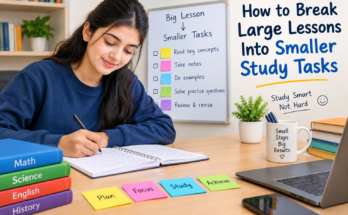
A difficult topic usually becomes easier when you spend enough time understanding it. Instead of avoiding the subject, break it into smaller parts.
For example, if a chapter contains ten concepts and you understand only three, do not try to memorize the entire chapter at once. Focus on one difficult concept, understand it, practice it, and then move to the next.
This approach makes studying feel more manageable and helps build confidence.
Use Active Recall
Active recall is another study skill that I find extremely useful. Instead of simply reading your notes again and again, close your book and try to remember what you studied.
You can ask yourself questions such as:
What were the main points of this chapter?
Can I explain this topic without looking at my notes?
What important definitions do I remember?
Can I solve a similar problem on my own?
If you cannot answer something, check your notes and try again.
Active recall helps you discover what you actually know and what still needs attention. It also gives you an opportunity to make mistakes during practice rather than discovering your weaknesses during an important exam.
Practice More After Making an Error
One mistake does not always mean you understand the solution after seeing the correct answer. Sometimes you need to practice similar questions.
Suppose you make a mistake while solving a mathematics problem. After checking the solution, try another question that uses the same method. If you can solve it correctly, you are beginning to understand the concept.
If you make another mistake, that is useful information too.
I believe practice should continue until you can explain the process clearly and complete similar questions without assistance.
Improve Your Time Management
Poor time management is one of the common reasons students struggle with their studies. Sometimes the problem is not a lack of ability. The student simply spends too much time on one task and leaves other work unfinished.
Creating a simple study schedule can help.
Instead of saying, “I will study all evening,” make your plan more specific. You could decide to study biology for one hour, practice mathematics for forty minutes, and review English vocabulary for thirty minutes.
Short, focused sessions can make studying easier because you know exactly what you need to accomplish.
It is also important to include short breaks. Studying continuously for several hours does not always mean that you are learning effectively.
Review Your Mistakes Regularly
Making a mistake once is normal. Repeating the same mistake many times means you may need a different study approach.
This is why regular review is important.
Set aside some time every week to look through your mistake notebook, practice difficult questions, and review topics where you previously struggled.
For example, you could spend fifteen or twenty minutes reviewing mistakes before starting your normal study session.
This simple habit can gradually turn weaknesses into strengths.
Ask for Help When You Need It
There is nothing wrong with asking for help. Sometimes a topic is difficult because the explanation you received was not clear enough.
You can ask a teacher, classmate, tutor, or another knowledgeable person to explain the topic differently.
When asking for help, try to be specific. Instead of saying, “I do not understand mathematics,” explain exactly where you become confused.
For example, you could say, “I understand the first step, but I do not understand why we use this formula in the second step.”
A specific question usually leads to a more useful answer.
Avoid Comparing Your Progress With Others
Every student learns at a different speed. Comparing yourself with someone who understands a topic faster can make you feel discouraged.
I prefer comparing my current progress with my previous performance.
If you previously scored poorly on a topic and now understand most of it, that is progress. If you used to need an hour to complete a task and now complete it in forty minutes, that is also improvement.
The goal should not always be to become better than another student. The goal should be to become a better version of yourself.
Learn to Accept Constructive Feedback
Feedback can sometimes feel uncomfortable, especially when it points out mistakes. However, useful feedback can improve your study skills.
When a teacher corrects your work, try not to focus only on the negative part. Look for information that can help you improve.
You can ask yourself:
What did I do well?
What needs improvement?
What should I do differently next time?
This mindset turns feedback into a learning opportunity.
Set Small and Realistic Study Goals
Large goals can sometimes feel overwhelming. Instead of saying, “I need to become excellent at this subject,” create smaller goals.
You might decide to understand one chapter, complete twenty practice questions, memorize ten important terms, or review yesterday’s mistakes.
Small goals are easier to track and can create a sense of progress.
Once you complete one goal, move to the next. Over time, these small improvements can produce significant results.

Develop a Growth Mindset
A growth mindset means believing that your abilities can improve through effort, practice, and better strategies.
If you think, “I am bad at this subject,” you may stop trying after making mistakes. A more useful thought is, “I do not understand this yet, but I can improve with practice.”
The word “yet” can make a big difference.
Mistakes do not define your intelligence. They provide information about what you need to learn next.
Take Care of Your Study Environment
Your environment can also affect your study habits. I find that a clean and organized study space makes it easier to concentrate.
Keep the materials you need nearby and remove unnecessary distractions. Put your phone away when possible, organize your notes, and make sure your workspace is comfortable.
Good study skills are not only about studying harder. They are also about creating conditions that make focused learning easier.
Give Yourself Time to Improve
Improving study skills does not happen overnight. You may change your routine and still make mistakes during the first few weeks.
That is completely normal.
The important thing is to continue observing your results and adjusting your approach.
If a particular study method does not work well for you, try another method. You might learn better through practice questions, flashcards, diagrams, discussions, or explaining concepts aloud.
The best study method is often the one that helps you understand and remember information effectively.
Final Thoughts
In my opinion, learning from mistakes is one of the most important study skills a student can develop. Mistakes can show you what you misunderstood, where your preparation was weak, and what you should change next time.
Instead of feeling embarrassed by every wrong answer, try to use it as useful feedback. Keep a mistake notebook, practice difficult topics, use active recall, manage your time, ask for help, and review your progress regularly.
Most importantly, be patient with yourself. Improvement is a process. Every mistake gives you another opportunity to understand something better.
When you stop seeing mistakes as proof of failure and start seeing them as part of learning, studying can become more productive and less stressful. With consistent effort and the right study habits, you can gradually improve your concentration, knowledge, confidence, and academic performance.