
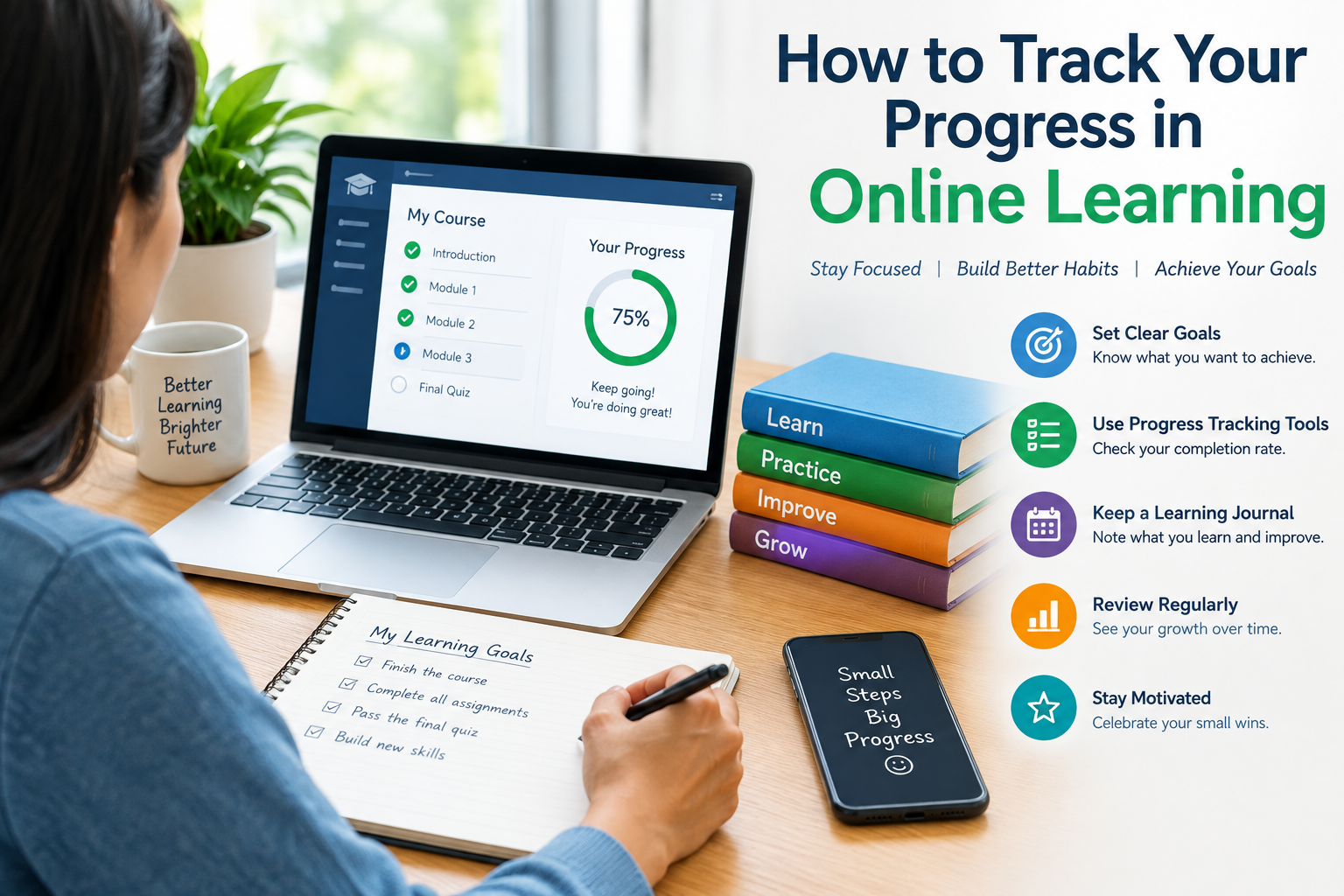
Online learning gives us the freedom to study whenever and wherever we want. However, this freedom can sometimes make it difficult to know whether we are actually making progress. When there is no teacher sitting beside us every day, it becomes our responsibility to understand what we have learned, what still needs attention, and whether we are moving toward our learning goals.
In my experience, tracking progress is one of the simplest ways to stay motivated during an online course. It gives a clear picture of where you started and how far you have come. You do not need complicated software or a detailed system. A notebook, calendar, spreadsheet, or the progress features already available in your online course can be enough.
In this article, I will share practical ways to track your progress in online learning and build a learning routine that is easier to maintain.
Set Clear Learning Goals
The first step in tracking online learning progress is knowing what you want to achieve. Without a clear goal, it becomes difficult to measure success.
Instead of saying, “I want to learn English,” make your goal more specific. You could say, “I want to improve my English vocabulary and learn 20 new words every week.”
The same idea works for other subjects. If you are learning graphic design, your goal might be to complete a beginner course and create three simple designs. If you are learning programming, you might want to understand basic concepts and build a small project.
Clear goals give you something measurable to follow. They also make it easier to recognize your progress.
Break Large Goals Into Small Steps
Large learning goals can sometimes feel overwhelming. This is especially true when an online course contains many lessons, assignments, quizzes, and projects.
I find it much easier to divide a large goal into smaller tasks. For example, instead of planning to finish an entire course in one week, you can decide to complete two lessons each day.
Small steps make progress easier to see. Every completed lesson gives you a feeling of achievement and encourages you to continue.
You can create a simple checklist containing your daily or weekly learning tasks. Mark each task after completing it. This simple habit can make your online learning routine more organized.
Use the Course Progress Tracker
Many online learning platforms provide built in progress tracking features. These may show completed lessons, quiz scores, assignment results, or overall course completion.
Make use of these features instead of ignoring them. Checking your course progress regularly can help you understand how much material you have completed.
However, I would not recommend judging your learning only by the percentage shown on the screen. Completing 80 percent of a course does not always mean you understand 80 percent of the subject.
Progress should include both completion and understanding.
Keep a Simple Learning Journal
A learning journal is another useful way to track your online learning progress. You do not need to write long entries every day.
At the end of a study session, write down three simple things.
What did I learn today?
What was difficult for me?
What do I need to practice?
These questions can help you understand your learning process. After a few weeks, you can look back at your notes and see how your knowledge has developed.
A learning journal can also show you patterns. For example, you may discover that you understand videos easily but struggle with practical exercises. This information can help you adjust your study method.
Record Your Study Time
Tracking study time can help you understand how consistently you are learning. You can use a calendar, notebook, timer, or simple spreadsheet.
For example, you might record:
Monday: 45 minutes
Tuesday: 60 minutes
Wednesday: 30 minutes
Thursday: 50 minutes
Friday: 60 minutes
The purpose is not to compete with other learners. The purpose is to understand your own routine.
If you notice that you are studying regularly, that is a positive sign. If your study time keeps decreasing, it may be a sign that you need to change your schedule.
Remember that longer study sessions are not always better. Consistent and focused learning is usually more useful than spending many hours studying without concentration.
Track Your Quiz and Assignment Results
Quiz scores and assignment results can provide useful information about your learning progress. They can show which topics you understand and which areas require more practice.
Do not become discouraged by a low score. Instead, treat it as feedback.
For example, if you score 90 percent on one topic but only 60 percent on another, the lower score tells you where to spend more time.
You can keep a simple record of your results and compare them over time. If your scores improve after reviewing difficult topics, you can see direct evidence that your study efforts are working.
Test Yourself Without Looking at Your Notes
One of the best ways to measure online learning progress is to test yourself without checking your notes.
After completing a lesson, close your course material and try to explain what you learned in your own words.
Ask yourself questions such as:
What was the main idea?
Can I explain this topic to someone else?
Can I give an example?
Can I solve a related problem?
If you cannot answer these questions, it does not necessarily mean you failed. It simply shows that the topic needs another review.
This type of self testing can give you a more accurate picture of your knowledge than simply watching lessons or reading notes.
Create Weekly Progress Reviews
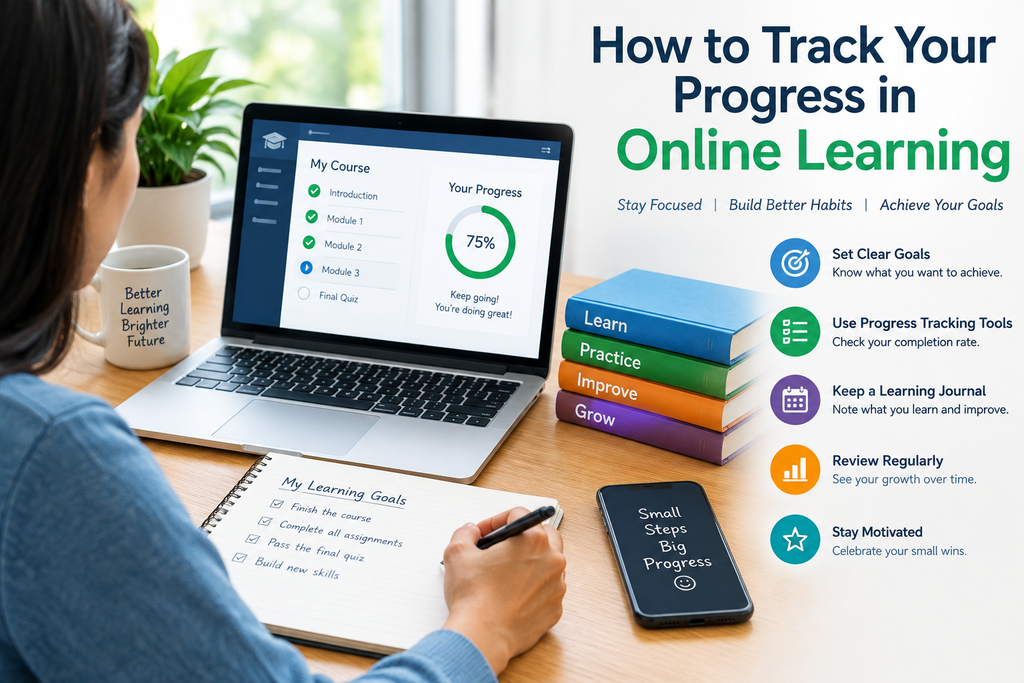
I recommend doing a short progress review at the end of every week. It does not need to take more than 10 or 15 minutes.
Look at the goals you created at the beginning of the week. Check which tasks you completed and which ones you missed.
Then ask yourself what worked well and what caused problems.
Maybe you studied well in the morning but struggled at night. Maybe you planned too many tasks for one day. Maybe certain lessons required more time than expected.
Use this information to create a better plan for the following week.
Measure Skills, Not Just Course Completion
Course completion is useful, but real learning progress is often about skills.
Imagine you are learning photography. Completing ten lessons is not the final goal. The real goal may be taking better photographs.
If you are learning writing, progress could mean writing clearer articles. If you are learning coding, progress could mean creating a working program.
Think about what you want to do with the knowledge you are gaining. Then create small practical projects that allow you to demonstrate your skills.
This is one of the best ways to know whether online learning is actually working for you.
Keep a Record of Your Achievements
It is easy to focus on what you still have to learn and forget what you have already accomplished.
Create a simple achievement list. Add completed courses, projects, certificates, skills, successful assignments, and other important milestones.
Looking at this list can be motivating when you feel that your progress is slow.
Sometimes progress is not obvious from one day to another. When you compare your current abilities with where you started several months ago, the difference can become much clearer.
Avoid Comparing Your Progress With Others
Every learner has a different schedule, background, learning style, and amount of available time.
Someone else may finish a course in two weeks while you take two months. That does not automatically mean they are learning better than you.
Your main comparison should be with your previous performance.
Ask yourself whether you understand more today than you did last month. Ask whether you can perform tasks that were difficult for you before.
Personal improvement is a much healthier measure of online learning progress.
Adjust Your Learning Plan When Necessary
Tracking progress is not only about recording information. It is also about using that information to make better decisions.
If your progress is slower than expected, look for the reason.
Perhaps your goals are too ambitious. Perhaps you need more practice. Perhaps your study environment is distracting. Perhaps you are using a learning method that does not work well for you.
Do not be afraid to change your plan. A flexible learning routine can be more effective than following a strict schedule that does not fit your needs.
Stay Consistent and Celebrate Small Wins
Online learning requires patience. Some days will be productive, while other days may not go as planned.
The important thing is to keep moving forward.
Celebrate small achievements. Completing a difficult lesson, improving a quiz score, finishing an assignment, or understanding a confusing concept are all meaningful steps.
When you recognize these small wins, learning can feel more rewarding.
Final Thoughts
Tracking your progress in online learning does not have to be complicated. The most important thing is to create a system that you can actually maintain.
Start by setting clear learning goals. Break those goals into smaller tasks and use course progress trackers when available. Keep a simple learning journal, record your study time, review your quiz results, and test your knowledge regularly.
Most importantly, measure real skills instead of focusing only on course completion. Look at how much you can do now compared with what you could do when you started.
From my point of view, progress becomes much easier to manage when you can see it clearly. A simple checklist or weekly review can provide the motivation needed to continue when an online course starts feeling difficult.
Online learning is a journey, and everyone moves at a different pace. If you stay consistent, review your progress, and make adjustments when necessary, you can build better learning habits and move steadily toward your goals.