Exam revision can sometimes feel difficult, especially when there is a lot of information to remember in a short amount of time. I have found that one of the simplest ways to make revision easier is to use flashcards. Flashcards are small study cards that help you review important information through questions, answers, definitions, facts, formulas, and concepts.
In my opinion, flashcards become really useful when they are made correctly. Simply writing a large amount of information on cards does not automatically make them effective. Good flashcards should be simple, focused, and easy to review. They should encourage you to remember information instead of simply reading it again.
In this article, I will share how I make effective flashcards for exam revision and how students can use them to improve their memory, understanding, and confidence before exams.
Understand What Flashcards Are
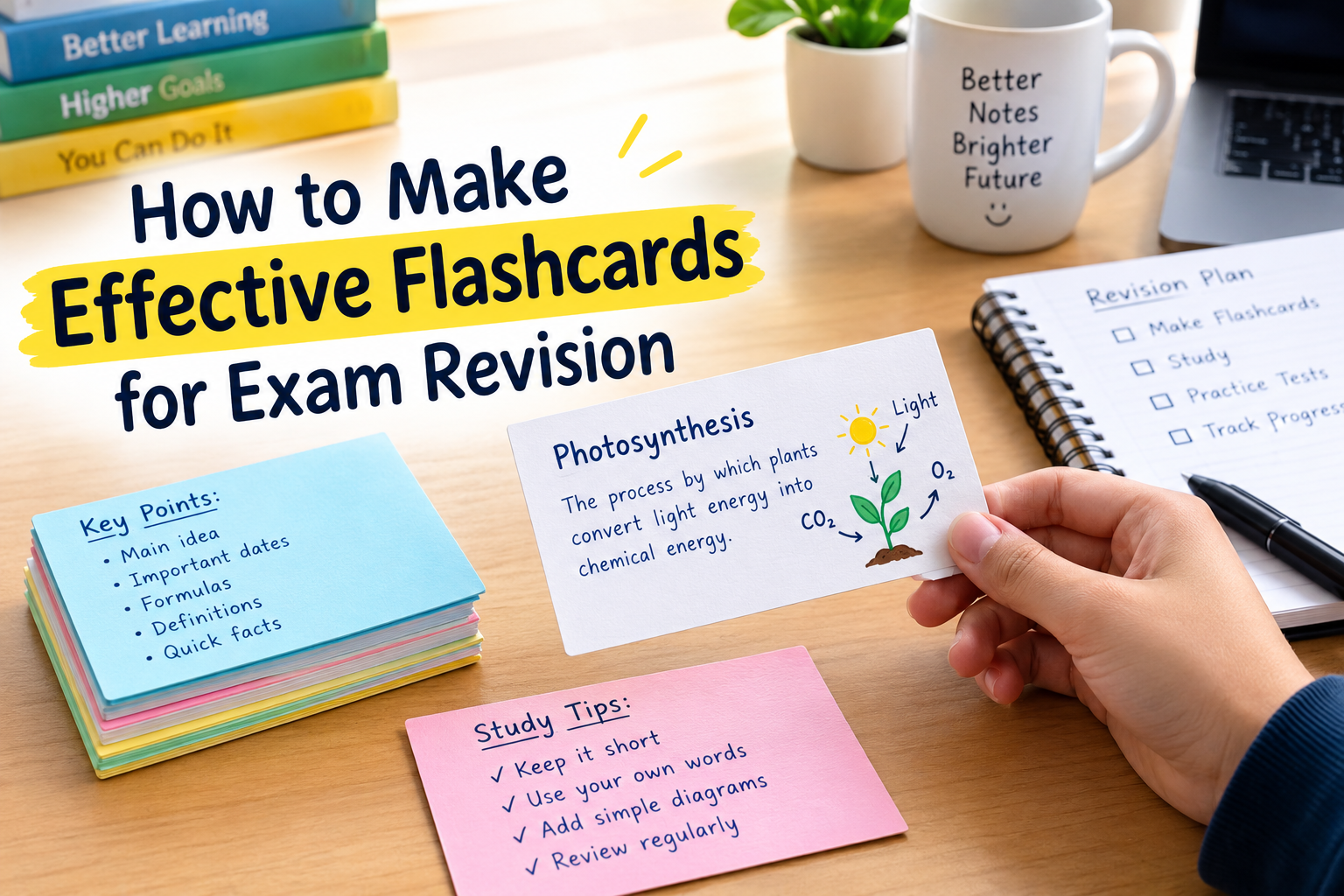
Before making flashcards, it is important to understand their purpose. A flashcard usually has a question or prompt on one side and the answer on the other side. For example, if you are studying biology, the front of the card could ask, “What is photosynthesis?” The back could contain a short explanation.
The main purpose is active recall. Instead of looking at your notes and recognizing information, you try to remember the answer yourself. This makes your study session more active.
I personally think this is one of the biggest advantages of flashcards. They force me to think about the information instead of simply reading it.
Choose the Most Important Information
One common mistake students make is trying to put everything from their textbook into flashcards. This can create hundreds of cards that become difficult to manage.
I recommend choosing information that is important for your exam. Focus on definitions, important dates, formulas, vocabulary, key concepts, processes, rules, and facts that you frequently forget.
Before making a card, ask yourself whether the information is worth remembering. If the answer is yes, create a card. If it is a small detail that is unlikely to help with your exam, you may not need a separate card.
This approach keeps your flashcard collection focused and useful.
Keep Each Flashcard Simple
An effective flashcard should usually focus on one idea. Avoid putting an entire paragraph on the answer side.
For example, instead of writing a long explanation about the causes of climate change, create several cards covering individual points.
One card could ask about greenhouse gases. Another could ask about fossil fuels. Another could ask about deforestation.
Breaking information into smaller pieces makes revision easier. When a card contains too much information, it can become difficult to remember what the actual question is testing.
Simple flashcards are also faster to review, which is important when preparing for exams.
Write Questions Instead of Statements
One of my favorite ways to create better flashcards is to turn information into questions.
Instead of writing:
“Water boils at 100 degrees Celsius.”
Write:
“At what temperature does water boil at normal atmospheric pressure?”
The question makes you actively search your memory for the answer. This is more useful than simply looking at a statement.
You can create questions from your textbook, class notes, assignments, and previous revision materials. Try to make the questions clear enough that you immediately understand what you need to recall.
Use Your Own Words
When creating flashcards, I recommend writing answers in your own words whenever possible. Copying complicated textbook sentences can make revision harder.
If a concept is difficult, first understand it properly and then explain it using simple language.
For example, instead of copying a complicated scientific definition, write a shorter explanation that keeps the important meaning.
Using your own words can make information easier to understand and remember. It also helps you notice whether you actually understand the topic.
Add Examples When They Help
Some subjects are easier to remember when you include examples.
For mathematics, you can put a formula on one side and a simple example on the other. For English vocabulary, you can include a word and use it in a sentence. For science, you can include a process and a practical example.
Examples can connect abstract information to something easier to understand.
However, I would avoid adding unnecessary details. The purpose of an example is to support memory and understanding, not to make the flashcard crowded.
Use Visuals Carefully
Visual information can make some flashcards more memorable. You can add simple diagrams, symbols, arrows, or small illustrations when they are useful.
For subjects such as biology, geography, science, and mathematics, a small diagram can sometimes explain an idea better than several sentences.
You do not need to become an artist. Even a simple drawing can be useful if it helps you remember the information.
The important thing is that the visual should support the topic rather than distract you from it.
Use Different Types of Questions
Effective flashcards do not always have to follow the same question and answer pattern.
You can create definition cards, comparison cards, formula cards, vocabulary cards, process cards, and application questions.
For example, you could ask:
“What is the difference between renewable and nonrenewable energy?”
This type of question encourages deeper thinking.
You can also create cards that ask you to explain why something happens rather than simply identify a fact. These cards can be especially useful for subjects that require understanding rather than memorization.
Organize Your Flashcards by Topic
Organization can make exam revision much easier. I prefer separating flashcards according to subjects and topics.
For example, you might have separate groups for mathematics, biology, history, and English. Within each subject, you can create smaller groups for individual chapters.
This makes it easier to focus on one topic at a time.
You can also organize cards according to difficulty. Cards you already know can be reviewed less frequently, while difficult cards can receive more attention.
Review Flashcards Regularly
Making flashcards is only the first step. Regular review is what makes them valuable.
Instead of creating your cards and leaving them untouched until the night before the exam, review them throughout your study period.
Start with frequent review sessions. Once you become comfortable with certain cards, review them less often. Difficult cards should appear more frequently.
This approach helps you keep important information in your memory for longer.
Use Active Recall
When reviewing a flashcard, do not immediately look at the answer.
Read the question, pause, and try to answer it from memory. Even if you are not completely sure, make an effort before checking the back.
This small habit makes flashcard revision much more effective.
If you immediately flip every card without thinking, you may feel familiar with the information without actually being able to recall it during an exam.
I believe this is one of the most important rules of effective flashcard study.
Mix Easy and Difficult Cards
It can feel good to review cards you already know, but spending all your time on easy information does not provide much benefit.
Make sure your revision includes difficult cards as well.
When you get an answer wrong, do not feel discouraged. Mark the card and review it again later. Every mistake can show you where more revision is needed.
Over time, difficult cards can become easier because your brain gets more opportunities to recall the information.
Avoid Making Too Many Flashcards
More flashcards do not always mean better revision.
If you create thousands of cards, you may spend more time organizing and reviewing them than actually learning.
I prefer quality over quantity. A smaller collection of well written cards can be more useful than a huge collection filled with unnecessary information.
Focus on the most important exam material and the areas where you need the most practice.
Try Digital and Physical Flashcards
There are two common ways to make flashcards. You can create them by hand using index cards or paper, or you can use a digital flashcard application.
Physical cards can be useful because writing information by hand can make the study process feel more active. Digital cards are convenient because they are easy to organize, carry, edit, and review.
I think both methods can work well. The best option is the one that makes you comfortable enough to review your cards consistently.
Connect Flashcards With Practice Questions
Flashcards are excellent for remembering facts and concepts, but they should not be your only revision method.
For many subjects, you should also solve practice questions, past papers, quizzes, and problems.
For example, a mathematics flashcard can help you remember a formula, but solving questions helps you understand how to use that formula.
Similarly, history flashcards can help you remember dates and events, while practice questions can help you develop stronger written answers.
Using different revision methods gives you a more complete preparation strategy.
Create Flashcards Early
I recommend starting your flashcards before the exam is very close. Creating them early gives you enough time to review information several times.
You can create a few cards after completing each chapter instead of trying to make all of them in one long study session.
This also helps you identify weak areas while there is still enough time to improve.
Final Thoughts
In my view, effective flashcards are not about writing as much information as possible. They are about turning important information into simple questions that encourage active recall.
Keep each card focused on one idea, use your own words, include useful examples, organize cards by topic, and review difficult information regularly. Most importantly, try to answer every question before checking the answer.
Flashcards can become a powerful part of exam revision when they are combined with other study methods such as practice questions, note review, and regular revision sessions.
The biggest benefit is that they make studying more active. Instead of simply reading information again and again, you are constantly testing what you can remember. With consistent practice, this can make exam preparation feel more organized and manageable.
For me, the goal of using flashcards is simple: understand the topic, remember the important information, and feel more prepared when exam day arrives.