Improving test taking skills is one of the most useful things a student can do to achieve better academic results. In my opinion, preparing for a test is not only about studying the textbook for hours. It is also about knowing how to understand questions, manage time, stay focused, and present answers clearly. Many students know the subject well but still lose marks because they become nervous, misunderstand questions, or spend too much time on one problem.
I believe good test taking skills can be developed with regular practice. You do not need to be naturally good at exams. You simply need to understand your weaknesses and work on them step by step. In this article, I will share practical test taking strategies that can help students feel more confident and perform better in different types of exams.
Understand the Test Format
The first step toward improving test taking skills is understanding the format of your exam. Before test day, find out what types of questions you are likely to face. Some exams include multiple choice questions, while others require short answers, essays, calculations, or a combination of different formats.
Knowing the test format helps you prepare more effectively. If you know that your exam contains several long questions, you can practice writing complete answers within a limited amount of time. If it includes multiple choice questions, you can practice identifying the best answer quickly.
I always think students should study the instructions before beginning their preparation. Understanding how marks are distributed can also help you decide how much time and detail to give each question.
Study With a Clear Plan
Good test taking skills begin before you enter the examination room. A clear study plan makes preparation easier and reduces last minute stress.
Instead of trying to study everything in one sitting, divide your syllabus into smaller sections. Set realistic daily goals and give extra attention to topics that you find difficult.
For example, if you have ten chapters to prepare, do not wait until the final two days. Study a few chapters each day and leave enough time for revision. This approach helps you remember information better and gives you an opportunity to identify areas that need more practice.
A simple study schedule can also prevent you from spending too much time on one subject while ignoring another.
Practice With Past Papers
One of the most effective ways to improve test taking skills is practicing past papers. Past papers help you understand the style of questions and give you an idea of how much information you are expected to provide.
When practicing, try to recreate real test conditions. Set a timer and complete the paper without checking your notes. After finishing, review your answers carefully.
Do not only count your correct answers. Look at your mistakes and ask yourself why you made them. Perhaps you misunderstood the question, forgot an important fact, made a calculation error, or ran out of time.
This process turns mistakes into learning opportunities and gradually improves your exam performance.
Read Every Question Carefully
Reading questions carefully is a simple skill, but it can make a major difference. Sometimes students know the correct information but answer the wrong question because they read too quickly.
Before answering, identify the important words in the question. Words such as explain, compare, describe, calculate, identify, and discuss can require different types of answers.
For example, if a question asks you to compare two ideas, simply describing one idea may not be enough. You should explain the similarities and differences.
Taking a few extra seconds to understand what the question is asking can save you from losing unnecessary marks.
Manage Your Time Wisely
Time management is one of the most important test taking strategies. You should have a general idea of how much time you can spend on each section.
If your exam lasts two hours and contains several sections, divide your available time according to the marks and difficulty of each section. Keep a few minutes at the end for checking your work.
I recommend avoiding the habit of spending too much time on one difficult question. If you are stuck, move to another question and return to the difficult one later.
This strategy helps you complete more of the test and prevents one challenging question from taking away time from questions you could answer correctly.
Start With Questions You Understand
When the test begins, you do not always need to answer questions in exactly the order they appear. If the instructions allow it, you can begin with questions that you understand well.
Starting with easier questions can help you build confidence. It also allows you to secure marks before spending time on more challenging problems.
However, make sure you follow the instructions of your specific examination. Some tests require questions to be answered in a particular order.
Stay Calm During the Test
Test anxiety can make even familiar questions feel difficult. In my view, staying calm is just as important as knowing the subject.
If you suddenly feel nervous, pause for a moment and take a few slow breaths. Read the question again and focus only on what you need to do next.
Do not look around at how quickly other students are writing. Everyone works at a different pace, and someone turning pages quickly does not necessarily mean they are performing better.
Focus on your own paper, your own answers, and your own time.
Use the Process of Elimination
For multiple choice tests, the process of elimination can be extremely helpful. If you do not immediately know the answer, first remove the options that are clearly incorrect.
After eliminating incorrect choices, compare the remaining answers carefully. Look for details in the question that can help you select the best option.
Do not change an answer simply because you become nervous about it. Change your answer when you identify a clear reason that your original choice was incorrect.
Write Clear and Organized Answers
For written tests, presentation matters because clear answers are easier to understand and evaluate. Try to organize your response logically.
Start by directly answering the question. Then provide supporting information, examples, explanations, or calculations when necessary.
Avoid adding unrelated information just to make an answer longer. A focused and accurate answer is usually more effective than a long response that does not address the question.
If your exam allows headings, numbered points, or diagrams, use them when they make your answer easier to follow.
Learn From Your Mistakes
One of the best ways to improve test performance is to study your previous mistakes. After completing a practice test or receiving your exam results, do not simply look at your final score.
Create a list of mistakes and identify the reason behind each one. You may discover that you have problems with certain topics, careless errors, poor time management, or misunderstanding questions.
Once you understand the pattern, you can create a plan to improve it.
For example, if you repeatedly make calculation mistakes, spend more time checking your work. If you struggle with essay questions, practice creating outlines before writing complete answers.
Improve Your Concentration
Strong concentration can make studying and testing more effective. Try to practice answering questions without distractions.
Keep your phone away while studying and choose a quiet place whenever possible. Study in focused sessions and take short breaks when needed.
You can also improve concentration by getting enough sleep before an important test. Staying awake all night may give you extra study hours, but it can leave you tired and less focused during the exam.
A rested mind can often perform better than an exhausted one.
Check Your Answers
Always leave some time to review your test if possible. Checking your answers can help you catch simple mistakes.
Look for missing questions, incorrect calculations, spelling problems, incomplete answers, and mistakes caused by reading the question too quickly.
For multiple choice tests, make sure your selected answers are marked correctly. For written tests, check whether you answered every part of the question.
Do not spend the entire checking period changing answers without a clear reason. Focus on finding genuine mistakes.
Build Confidence Through Practice
Confidence does not usually appear overnight. It grows when you repeatedly prepare, practice, make mistakes, and improve.
If you find tests stressful, begin with short practice sessions. Gradually increase the number of questions and introduce time limits.
With regular practice, the test environment becomes more familiar. You start recognizing question patterns and become faster at deciding how to approach different problems.
This is why I believe practice is one of the strongest ways to improve test taking skills.
Final Thoughts
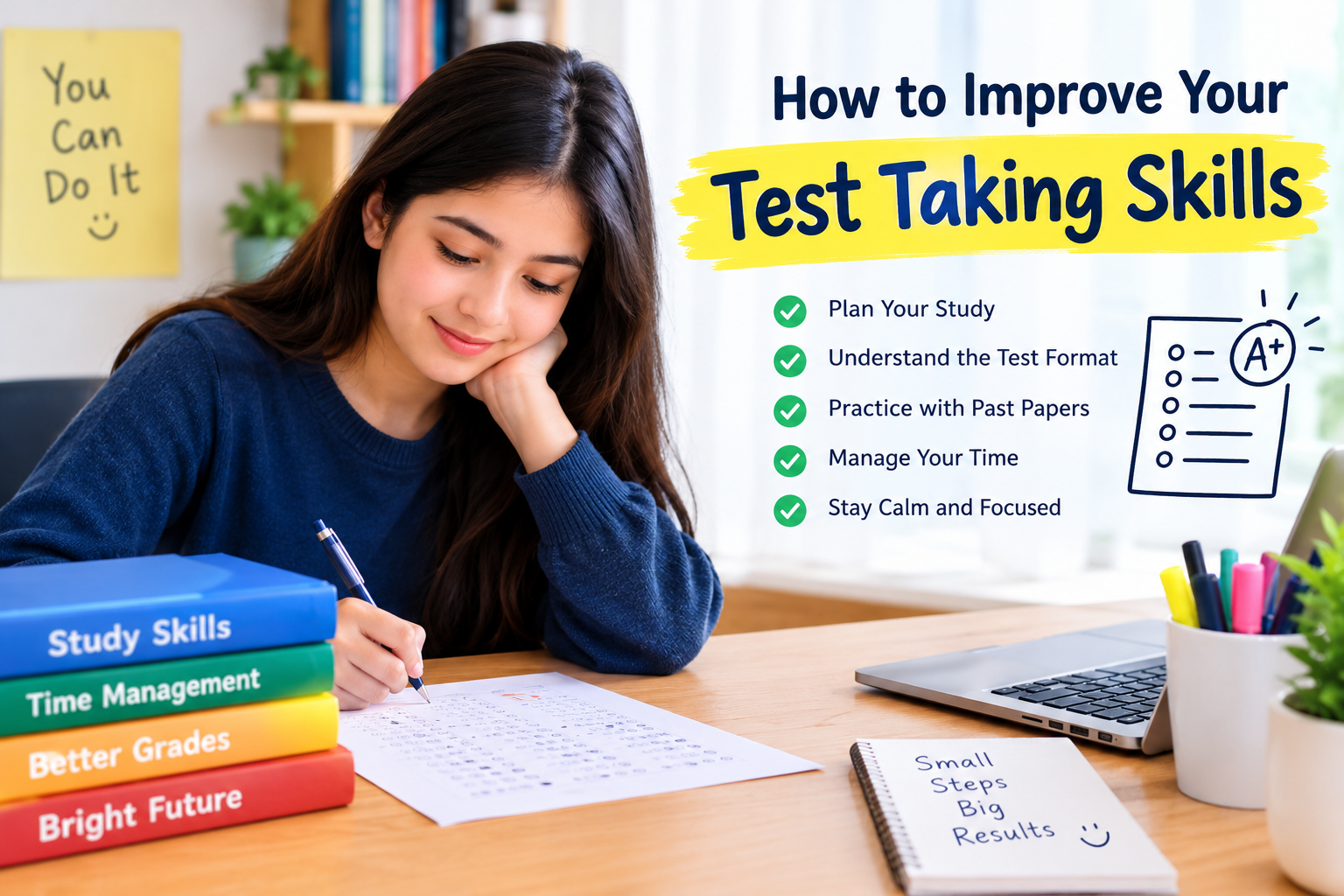
Improving your test taking skills is not about finding one magic technique. It is about combining several useful habits. Understand your test format, create a realistic study plan, practice past papers, read questions carefully, manage your time, stay calm, and learn from your mistakes.
From my point of view, the most important thing is to focus on progress rather than perfection. Every practice test can teach you something. Every mistake can show you what needs more attention.
When you prepare consistently and develop smart exam habits, you can enter the test room with greater confidence. Good test taking skills can help you use your knowledge more effectively and give yourself a better opportunity to achieve the results you are working toward.