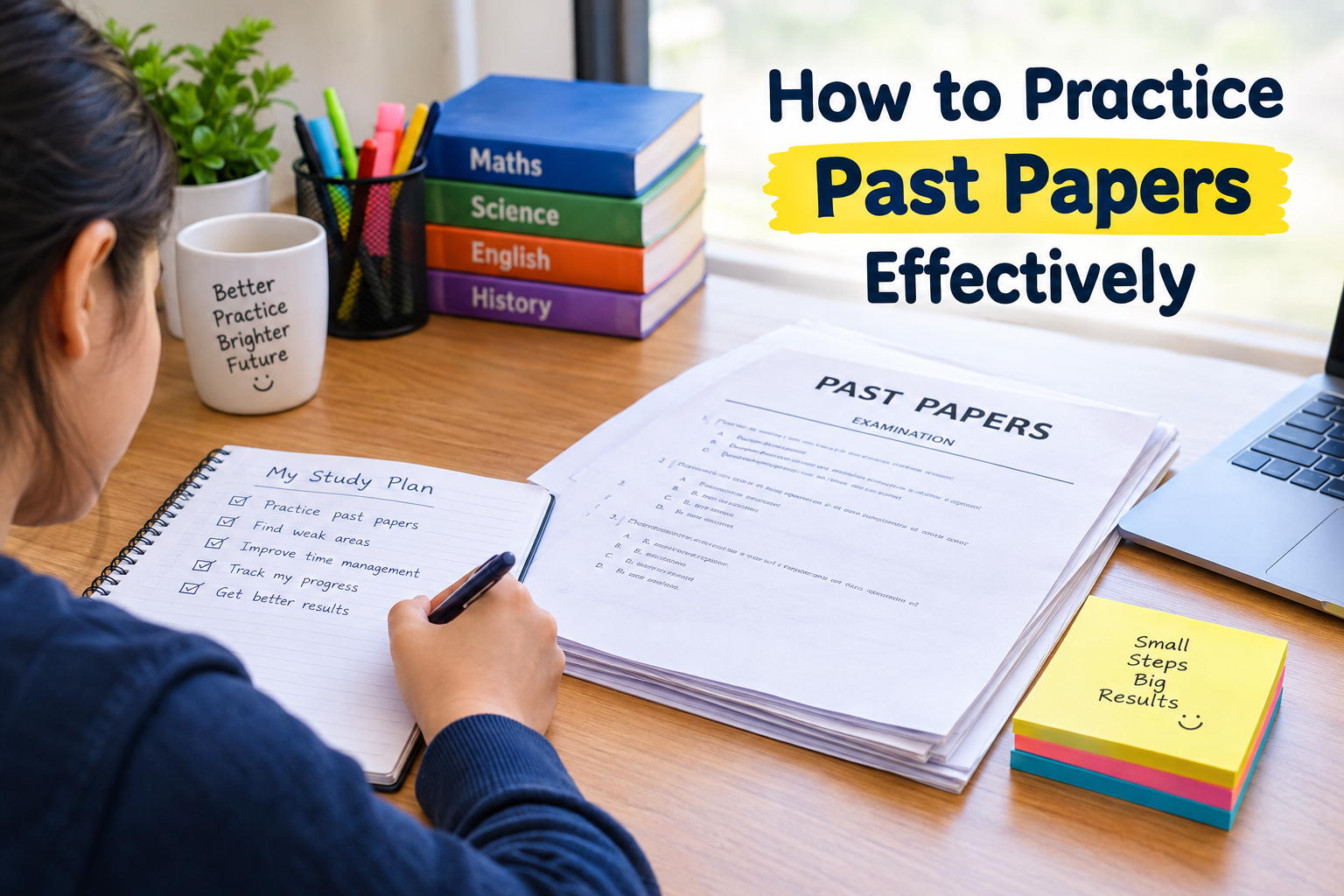
Preparing for an exam is not only about reading textbooks and memorizing notes. In my experience, one of the most useful ways to prepare for exams is to practice past papers. Past papers help me understand the exam pattern, recognize common question styles, improve my time management, and discover the topics that need more attention.
Many students collect past papers but do not use them properly. They may solve a paper once, check the answers, and then move on. I believe this misses the real benefit of past paper practice. The goal is not simply to complete questions. The goal is to learn from every paper and use the experience to improve future performance.
In this article, I will explain how to practice past papers effectively and how this simple study method can make exam preparation more organized and productive.
Why Past Papers Are Important
Past papers give you a practical idea of what to expect in an examination. Textbooks can explain the subject, but past papers show you how your knowledge may be tested.
When I practice past papers, I can see which topics appear regularly and which types of questions require more thinking. This helps me focus my study time on areas that matter.
Past papers can also reduce exam anxiety. When you become familiar with the question format, the real examination feels less unfamiliar. You already have experience reading similar questions and working under time pressure.
Another important benefit is that past papers help you identify weaknesses. You may think you understand a chapter until you try to answer questions about it. If you cannot solve a question, it gives you a clear signal that you need to review that topic.
Start With the Right Past Papers
The quality of your practice depends partly on the papers you choose. I recommend starting with past papers that match your current syllabus and examination pattern.
If your course has changed recently, be careful when using very old papers. Some questions may be based on topics that are no longer included in your syllabus.
Try to collect several recent past papers instead of depending on only one. Different papers can expose you to different question styles.
I also prefer organizing past papers by subject and year. This makes it easier to track my progress and return to papers later for additional practice.
Understand the Paper Before Solving It
Before starting a past paper, take a few minutes to understand its structure. Look at the number of questions, sections, marks, and recommended examination time.
This small step can make your practice more realistic.
For example, if an examination gives you two hours, try to complete the practice paper within the same amount of time. Do not give yourself unlimited time simply because you are studying at home.
Understanding the paper also helps you develop a strategy. You can decide which sections you are comfortable with and which questions may require more time.
Do Your First Practice Without Looking at Answers
One of the biggest mistakes students make is checking the answer immediately after reading a difficult question.
I believe it is better to try the question yourself first. Even if you are not completely sure about the answer, make a genuine attempt.
This shows you what you actually know without outside help.
When you look at the answer too quickly, you may feel that you understand the solution even though you may not be able to produce it independently during the exam.
Give yourself enough time to think. If you still cannot solve the question, mark it and continue. You can return to it later.
Practice Under Real Exam Conditions
If you want past papers to improve your exam performance, practice them like real examinations.
Choose a quiet place and remove unnecessary distractions. Keep your phone away and use only the materials that would normally be allowed in your examination.
Set a timer according to the actual examination duration.
This method helps you improve more than just your academic knowledge. It develops concentration, speed, decision making, and time management.
At first, you may struggle to finish the entire paper on time. That is completely normal. With regular practice, your speed should gradually improve.
Check Your Answers Carefully
After completing a past paper, checking your answers is just as important as solving the paper.
Do not simply look at your score and stop.
Go through every incorrect answer and try to understand why you made the mistake. Sometimes the problem is a lack of knowledge. In other cases, you may have misunderstood the question or made a simple calculation mistake.
I recommend creating a mistake list. Write down the questions you got wrong and briefly explain the reason.
For example, you might write that you forgot a formula, misunderstood a definition, made a calculation error, or did not read the question carefully.
This list becomes a valuable revision tool before the final examination.
Learn From Your Mistakes
The main purpose of past paper practice is improvement.
Getting questions wrong does not mean that your preparation is failing. Instead, mistakes show you exactly where you need to improve.
When I make a mistake, I try to understand the reason rather than simply memorizing the correct answer.
If a question is difficult because I do not understand the topic, I return to my textbook or study notes. After reviewing the topic, I attempt a similar question again.
This process helps turn mistakes into learning opportunities.
Repeat Difficult Questions
You do not need to solve every question only once.
If you get an important question wrong, return to it after reviewing the related topic. Try solving it again without looking at the previous solution.
This is particularly useful for mathematics, science, accounting, economics, and other subjects where solving problems requires practice.
For theory based subjects, you can also rewrite weak answers using your own words.
The goal is to make sure that you can answer independently instead of simply recognizing the correct answer.
Practice Different Years
Practicing papers from different years can give you a broader understanding of your examination.
You may notice that certain concepts appear repeatedly, although the wording of the question changes.
This teaches you an important lesson. Do not memorize answers word for word. Understand the underlying topic so you can handle the same concept when it is presented differently.
When reviewing several years of past papers, keep track of topics that appear frequently. These topics deserve special attention during revision.
Improve Your Time Management
Time management is one of the most important skills developed through past paper practice.
Some students know the material well but still lose marks because they spend too much time on one question.
While practicing, notice how much time you spend on different sections.
If one question takes much longer than expected, ask yourself whether you need more knowledge or whether you need a better strategy.
You can gradually learn when to move forward and when to return to a difficult question later.
Do Not Focus Only on Your Score
Your score is useful, but it should not be the only thing you measure.
For example, if you score 60 percent on your first practice paper and 70 percent on another, that improvement is encouraging. But you should also examine why your score changed.
Maybe you improved your understanding of a particular chapter. Perhaps you managed your time better. Maybe you made fewer careless mistakes.
These details provide more useful information than the final percentage alone.
Create a Past Paper Study Schedule
Regular practice is better than completing many papers in one day.
I prefer creating a simple schedule that gives me enough time to study topics between practice sessions.
For example, I might complete one past paper, review my mistakes, study the weak areas, and then attempt another paper after a short period.
This approach allows me to measure whether my understanding is actually improving.
Avoid leaving all past paper practice until the final few days before the exam. Starting earlier gives you enough time to identify weaknesses and fix them.
Use Past Papers With Your Study Notes
Past papers should not completely replace textbooks, notes, or other study materials.
I see them as a practical test of what I have learned.
If I cannot answer a question, I return to my study material and review the relevant information. Then I come back to the question and try again.
This creates a useful study cycle: learn the topic, practice the question, identify the mistake, review the topic, and practice again.
This method can make revision more active and effective.
Practice Writing Complete Answers
For subjects that require written answers, do not only think about the answer in your head.
Write it down.
Writing helps you practice explaining your knowledge clearly and quickly. It also allows you to see whether your answer contains enough information.
Pay attention to definitions, explanations, examples, calculations, and important points depending on the subject.
If your examination requires long answers, practice organizing your response logically so that you do not waste time deciding what to write during the real exam.
Stay Consistent
The biggest benefit of past paper practice comes from consistency.
You do not need to complete five papers every day. Even one carefully completed paper can be useful if you properly review your mistakes afterward.
I believe quality is more important than quantity.
A student who completes fewer papers but learns from every mistake may improve more than someone who completes many papers without reviewing them.
Final Thoughts
Learning how to practice past papers effectively can make a major difference in exam preparation. Past papers help you understand the examination format, improve time management, identify weak areas, practice answering questions, and build confidence.
From my point of view, the most important thing is not how many papers you complete. It is what you learn from each paper.
Try to solve past papers under realistic conditions, check every answer carefully, keep a record of your mistakes, review weak topics, and repeat difficult questions. As your practice continues, you should become more comfortable with the examination format and more confident in your preparation.
Remember that every past paper is an opportunity to learn something new. A wrong answer is not wasted effort if you understand why it was wrong and make sure you do better next time.
With regular practice, patience, and a clear study plan, past papers can become one of the most effective tools in your exam preparation.