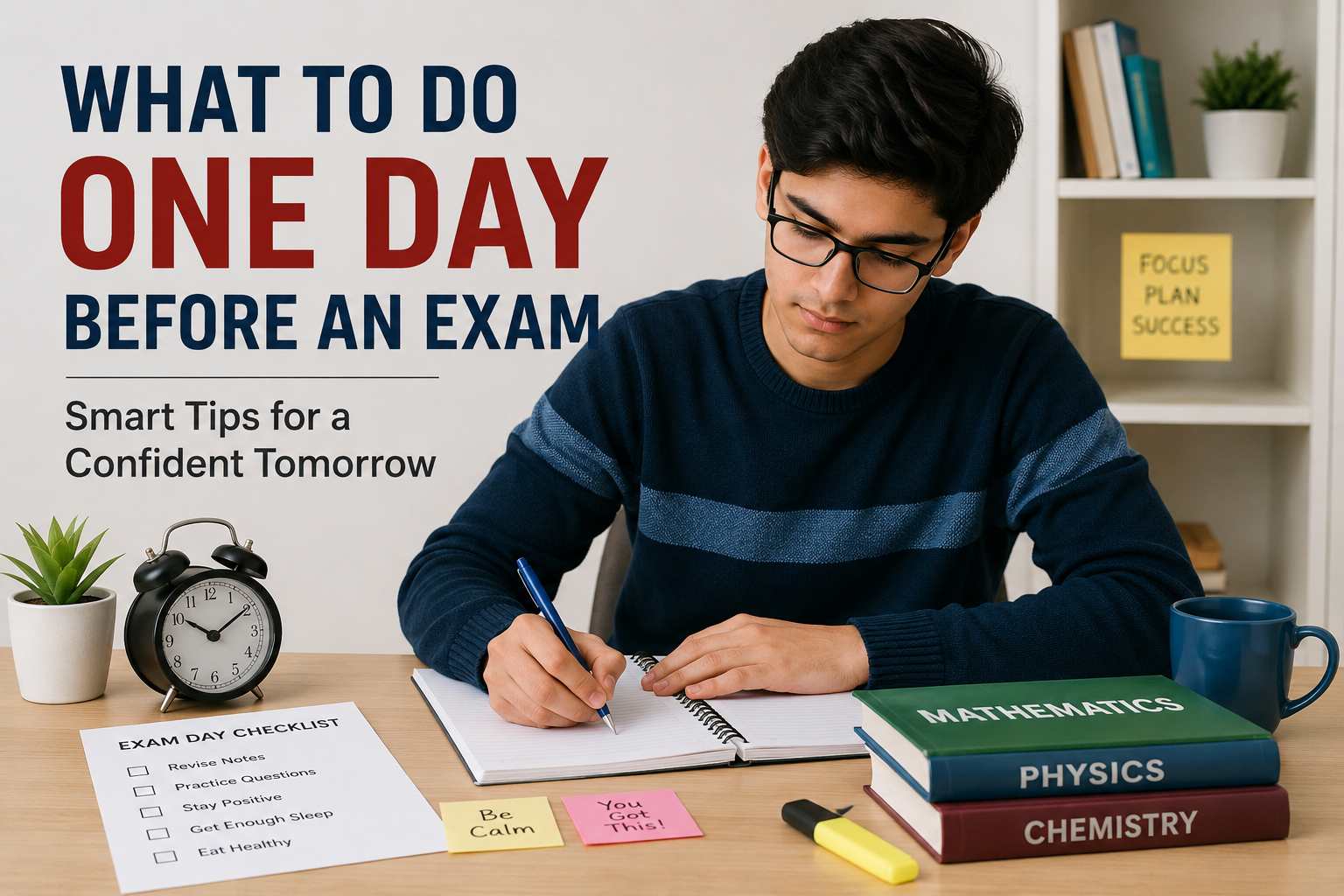
The day before an exam can feel stressful, especially when you start thinking about everything you have studied and everything you still need to remember. I have found that the final day should not be about trying to learn the entire syllabus again. Instead, it should be about smart revision, staying calm, preparing everything you need, and getting enough rest.
A good plan for the day before an exam can make a big difference. When your mind is organized, you feel more confident and you can enter the exam room with a much clearer focus. In this article, I will share what I believe students should do one day before an exam to make the final hours useful and productive.
Start With a Simple Revision Plan
The first thing I recommend doing one day before an exam is making a simple revision plan. Do not make a complicated timetable that takes more time to organize than to follow.
Look at your syllabus and divide the remaining study time into small sessions. Focus on the subjects and topics that are most important. If there are chapters that you already understand well, you do not need to spend hours reading them again.
I prefer to start with the topics that I find difficult. This gives me enough time to review them without creating unnecessary pressure later in the day.
Your revision plan should include short breaks. Studying continuously for many hours can make you tired and reduce your concentration. A short break after each focused study session can help your brain stay active.
Review Important Topics
One day before an exam is not the best time to read every page of every textbook. Your goal should be effective exam revision rather than complete reading.
Review important formulas, definitions, concepts, dates, diagrams, vocabulary, and key points. If your teacher has highlighted certain topics during classes, give those topics extra attention.
I also like to review questions that have appeared in previous tests or practice papers. They can help you understand the type of questions you may need to answer and show you which areas require more attention.
Try to understand the information instead of simply reading it again and again. Ask yourself questions and try to answer them without looking at your notes. This is a much more active way to revise.
Practice Without Looking at Your Notes
One of the most useful things you can do before an exam is test yourself.
After reviewing a topic, close your book and explain the main idea in your own words. If you can explain it clearly without checking your notes, you probably understand it well.
You can also solve practice questions. For subjects such as mathematics, physics, chemistry, accounting, or other problem based subjects, practice is especially important.
Do not spend all your time checking the answers immediately. First try to solve the question yourself. Then compare your answer with the correct solution and identify your mistakes.
In my opinion, mistakes made during revision can actually be helpful because they show you what you need to improve before the real exam.
Do Not Start Completely New Topics
A common mistake students make one day before an exam is trying to learn everything they have ignored until that point.
If there is a small topic that you have not reviewed, you can certainly look at it. However, starting a large and difficult chapter from zero can create more stress than benefit.
At this stage, it is better to strengthen what you already know and improve your weak areas. A calm and focused revision session is usually more useful than rushing through a huge amount of new information.
Remember that the purpose of the final day is preparation, not panic.
Organize Your Exam Materials
Another important thing to do one day before an exam is prepare everything you will need.
Check your exam instructions and make sure you know the location, reporting time, and rules. Prepare your pens, pencils, eraser, ruler, calculator, identification documents, water bottle, or any other permitted items.
If your exam requires special equipment, check it in advance. Do not wait until the morning of the exam to search for something important.
I personally believe that preparing these things the night before removes a lot of unnecessary stress. When everything is ready, you can wake up knowing that you do not have to rush around looking for your supplies.
Check the Exam Time and Location
It may sound simple, but checking the exam time and location is extremely important.
Make sure you know exactly when the exam begins. If you are traveling to a school, college, university, or examination center, think about how long the journey will take.
If possible, plan to arrive early. Unexpected traffic, transportation problems, or other delays can happen. Leaving with enough time gives you a better chance of reaching the exam center calmly.
I would rather arrive early and sit quietly for a few minutes than arrive late and begin the exam feeling nervous.
Eat a Healthy Meal
Your brain needs energy to work properly, so do not ignore food during exam preparation.
The day before an exam, try to eat normal balanced meals. Include foods that make you feel comfortable and energized. Avoid experimenting with unusual foods that may upset your stomach.
Drink enough water throughout the day. Staying hydrated can help you feel more comfortable and focused.
You also do not need to consume large amounts of coffee or energy drinks just because an exam is approaching. Too much caffeine can make some people feel restless or interfere with sleep.
A simple, familiar meal is usually a better choice than relying on unhealthy snacks throughout the day.
Take Short Breaks
Studying for the entire day without taking a break may sound productive, but it can make you mentally exhausted.
I recommend taking short breaks between revision sessions. Stand up, walk around, stretch, drink some water, or simply rest your eyes for a few minutes.
Breaks give your mind an opportunity to recover. When you return to your books, you may find it easier to concentrate.
The key is to keep breaks controlled. A five or ten minute break can become an hour if you start scrolling through social media or watching videos without checking the time.
Stay Away From Distractions
Your phone can become one of the biggest distractions during exam revision.
If you are studying an important topic, keep unnecessary notifications away. You can put your phone on silent or leave it in another room during your study session.
Social media can create another problem because seeing other students discussing their preparation may increase your anxiety. Someone might say they have completed ten chapters while you have completed six. That comparison does not necessarily tell you anything useful.
Focus on your own preparation. Everyone has a different learning speed and different strengths.
Prepare Your Clothes and Morning Routine
Another small but useful step is preparing your clothes for the next morning.
Choose something comfortable and appropriate for the exam environment. Put your clothes, shoes, bag, and study materials in one place.
You can also decide what time you will wake up and when you will leave home.
This may seem like a small detail, but it makes your morning easier. Instead of making many decisions when you are already nervous, you can simply follow your plan.
Get Enough Sleep
In my opinion, getting enough sleep is one of the most important things to do one day before an exam.
Many students stay awake all night trying to memorize more information. They may feel that sacrificing sleep gives them extra study time. However, being extremely tired during an exam can make it harder to concentrate, remember information, and think clearly.
Try to finish serious revision at a reasonable time and give yourself an opportunity to sleep.
If you are worried that you will forget something, review a short list of important points before going to bed. Then close your books and allow yourself to rest.
A fresh mind can be more valuable than another few hours of exhausted studying.
Avoid Last Minute Panic
It is completely normal to feel nervous before an exam. However, panic does not help you study effectively.
If you suddenly remember a topic you did not revise, take a breath and decide whether it is genuinely important. If it is, spend a limited amount of time reviewing it. If it is not, move forward with your plan.
Do not allow one difficult topic to make you believe that you are completely unprepared.
Think about the work you have already completed. Remind yourself that you do not need to know everything perfectly to perform well.
Review Your Personal Notes
Before finishing your revision, go through your own short notes.
Your personal notes are often more useful at this stage than reading a large textbook again. Look at important formulas, keywords, definitions, common mistakes, and concepts that you frequently forget.
You can create a one page revision sheet for your own use. Keep it simple and organized.
The goal is not to write another textbook. The goal is to create something that helps you quickly refresh your memory.
Keep a Positive Mindset
Your mindset can influence how you approach an exam.
Instead of repeatedly telling yourself that you will fail, remind yourself that you have prepared and that you can give your best effort.
Positive thinking does not mean pretending that everything is perfect. It means focusing on what you can control.
You can control your revision, sleep, preparation, time management, and attitude. You cannot control every question that appears on the exam paper.
So focus your energy on the things you can actually change.
What to Do on the Morning of the Exam
The morning of the exam should be calm.
Wake up with enough time to get ready without rushing. Eat a normal breakfast if you usually eat breakfast. Drink some water and check that you have all your required materials.
If you want to revise in the morning, keep it light. Review key points instead of attempting to study an entire chapter.
Give yourself enough time to reach the exam center. Once you arrive, avoid getting into stressful conversations about how much everyone has studied.
Take a few deep breaths and focus on the exam ahead.
Final Thoughts
Knowing what to do one day before an exam can help you turn a stressful day into a productive one. The final day is not about studying from morning until midnight. It is about smart revision, preparation, rest, and confidence.
Review the most important topics, practice questions, organize your exam materials, eat properly, take short breaks, avoid distractions, and get enough sleep. Most importantly, do not let fear control your final preparation.
From my point of view, the best exam preparation is not about how many hours you sit with a book. It is about how effectively you use those hours. If you spend the final day with a clear plan and a calm mind, you give yourself a much better chance of entering the exam room prepared and confident.
An exam is only one part of your academic journey. Do your best, trust your preparation, and remember that staying calm can be just as important as studying hard.