Being a student is not only about attending classes, completing assignments, and preparing for exams. In my opinion, some of the most valuable lessons students learn are the skills they can use in everyday life. Good grades are important, but practical skills can help students become more confident, organized, responsible, and prepared for their future.
I believe every student should spend some time developing useful skills alongside academic knowledge. These skills can make studying easier, improve communication, and help students handle challenges more effectively. The good thing is that most of these skills can be learned through regular practice.
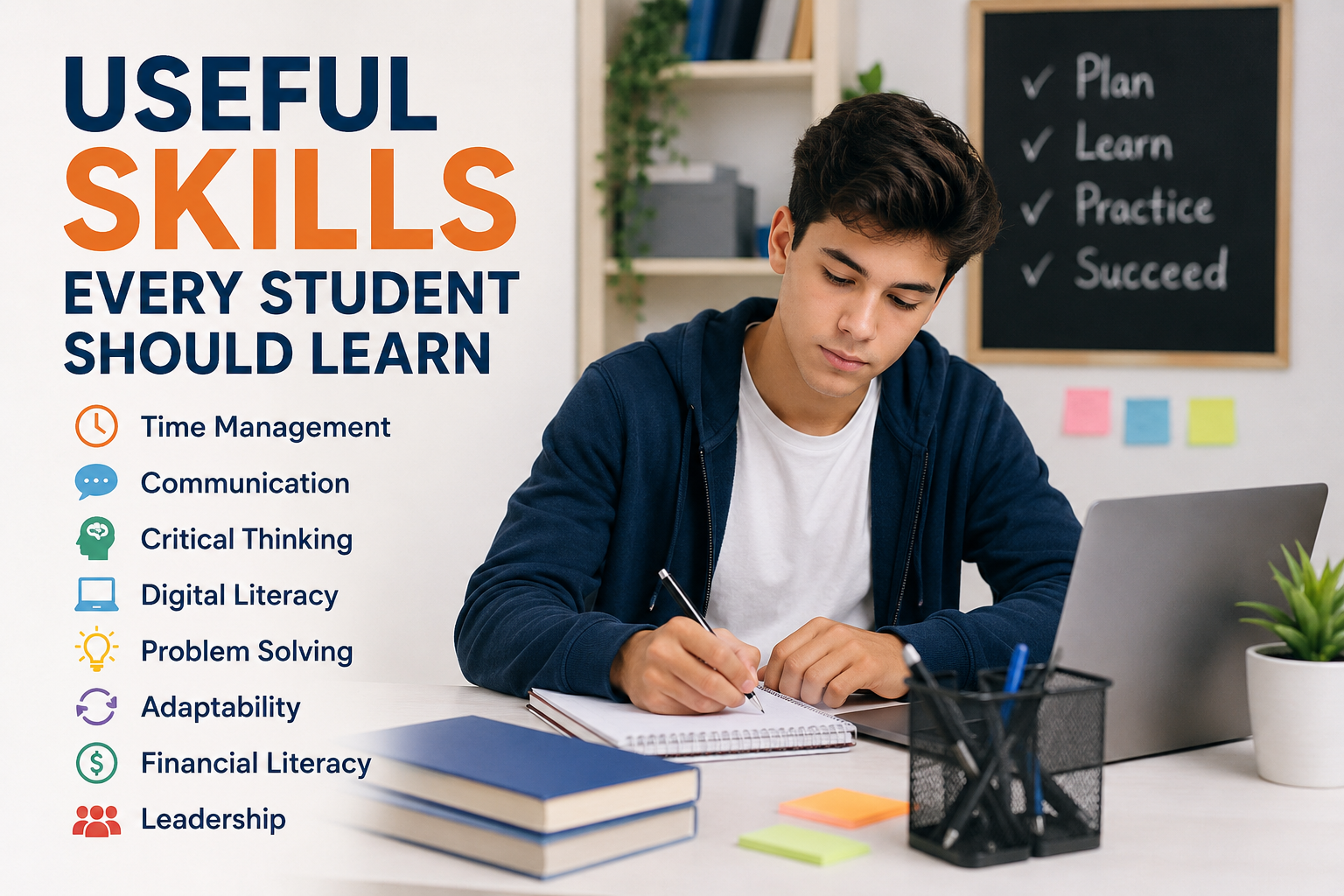
1. Time Management
Time management is one of the most useful skills every student should learn. Students usually have many responsibilities, including classes, homework, exams, family activities, hobbies, and personal time. Without proper planning, it can become difficult to manage everything.
I have found that making a simple daily schedule can make a big difference. Students can write down their important tasks and decide which ones need attention first. Breaking large assignments into smaller tasks can also make work feel easier.
Good time management does not mean studying all day. It means knowing how to use available time wisely while leaving enough time for rest and other activities.
2. Effective Communication
Communication is another important skill for students. A student may have excellent knowledge, but if they cannot explain their ideas clearly, they may struggle in school, university, or professional life.
Students should learn how to speak politely, listen carefully, ask useful questions, and express their opinions clearly. Writing is also an important part of communication. Learning how to write clear emails, assignments, applications, and messages can be useful in many situations.
In my view, students should not be afraid to participate in discussions. Every conversation is an opportunity to improve communication skills.
3. Critical Thinking
Critical thinking helps students understand information instead of simply accepting everything they hear or read. With so much information available online, students need to learn how to identify reliable information and think carefully before making conclusions.
A student with good critical thinking skills asks questions such as why something is true, what evidence supports it, and whether another explanation is possible.
This skill is especially useful when researching topics, preparing assignments, reading news, or making important decisions. It can also help students avoid misleading information on social media and websites.
4. Problem Solving
Problems are a normal part of student life. Sometimes an assignment seems difficult, a project does not go as planned, or a student struggles to understand a particular topic.
Instead of immediately giving up, students should learn how to approach problems step by step. First, they can identify the actual problem. Then they can think about possible solutions and consider which solution is most practical.
I believe problem solving becomes easier with practice. Every difficult situation can teach students something that may help them handle a similar challenge in the future.
5. Digital Literacy
Technology is now an important part of education and everyday life. Because of this, digital literacy is one of the essential skills students should develop.
Students should know how to use common digital tools, search for information online, organize files, create documents, and communicate through digital platforms. They should also understand basic online safety.
Knowing how to create strong passwords, recognize suspicious links, protect personal information, and use websites responsibly can help students stay safer online.
Digital literacy is not only about knowing how to use a computer. It is also about understanding how to use technology responsibly and effectively.
6. Research Skills
Research skills can make studying much easier. Students often need to collect information for assignments, presentations, projects, and exams.
A good student should learn how to search for information using specific keywords, compare different sources, and identify trustworthy information. It is also important to understand the difference between reliable sources and unsupported claims.
I recommend students keep their research organized. Saving useful sources and taking short notes while researching can save a lot of time later.
7. Financial Literacy
Financial literacy is a skill that many students overlook. However, understanding money can be extremely useful as students become more independent.
Students should learn basic concepts such as budgeting, saving, spending wisely, and distinguishing between needs and wants. Even a simple personal budget can teach students how to control their expenses.
Learning about money at a young age can also help students develop responsible financial habits. They do not need to become financial experts. Understanding the basics is already a valuable start.
8. Teamwork
Students frequently work with classmates on projects, presentations, sports activities, and other tasks. This makes teamwork an important skill.
Good teamwork means listening to others, sharing responsibilities, respecting different opinions, and completing your part of the work on time.
I think students should learn that successful teamwork is not about one person doing everything. Each person should contribute according to their strengths while helping the group achieve a common goal.
9. Adaptability
Life does not always follow our plans. Classes can change, assignments can become more difficult, and unexpected situations can appear. Adaptability helps students handle these changes without becoming overwhelmed.
An adaptable student is willing to learn new methods and try different approaches. For example, if a particular study technique is not working, the student can experiment with another method.
In my opinion, being comfortable with change is one of the most valuable skills a student can develop because the future will continue to change.
10. Self Discipline
Motivation can come and go, but self discipline helps students continue working even when they do not feel motivated.
A student with self discipline can create a routine, avoid unnecessary distractions, and complete important tasks before relaxing.
This does not mean students should be extremely strict with themselves. It means learning to make responsible choices. Sometimes studying for thirty focused minutes is more useful than spending several hours with constant distractions.
11. Public Speaking
Public speaking can feel uncomfortable, especially for students who are naturally quiet. However, practicing this skill can increase confidence.
Students can start with small activities, such as explaining a topic to a friend or presenting a short idea in class. With regular practice, speaking in front of others can become easier.
Public speaking is useful far beyond school. Students may need it during university presentations, interviews, meetings, and professional events.
12. Emotional Intelligence
Academic knowledge is important, but students also need to understand their emotions and interact positively with others. Emotional intelligence involves recognizing feelings, controlling reactions, showing empathy, and building healthy relationships.
A student who understands their emotions may find it easier to deal with stress, disappointment, and disagreements.
I believe learning to stay calm during difficult situations is a valuable life skill. Students should understand that experiencing emotions is normal. What matters is learning how to respond to them in a healthy and respectful way.
13. Basic Leadership
Leadership is not only for managers or business owners. Students can develop leadership skills through school projects, clubs, sports, volunteer activities, and group assignments.
Good leadership involves responsibility, communication, decision making, and helping others. A good leader does not simply tell people what to do. They listen, support the team, and take responsibility for their decisions.
Students can practice leadership by taking responsibility for small tasks and gradually accepting greater challenges.
14. Creativity
Creativity helps students look at problems from different perspectives. It is useful not only in art but also in writing, science, technology, business, and everyday problem solving.
Students can develop creativity by reading different types of books, learning new hobbies, writing, drawing, experimenting, or trying new ways to complete familiar tasks.
I think students should give themselves permission to make mistakes while learning. Creativity often grows when people are willing to experiment.
15. Learning How to Learn
Perhaps the most valuable skill every student can develop is learning how to learn. Education does not stop when school or university ends. People continue learning throughout their lives.
Students should discover which study methods work best for them. Some may prefer making notes, while others learn better through practice questions, discussions, diagrams, or teaching the topic to someone else.
The important thing is to understand your own learning process and continue improving it.
How Students Can Build These Skills
The best way to develop useful skills is through regular practice. Students do not need to master everything at once. Trying to improve one or two skills at a time can be more realistic.
For example, a student can start with time management by creating a weekly schedule. After becoming comfortable with that habit, they can focus on communication or digital literacy.
Small improvements can eventually become strong habits. Students should also remember that mistakes are part of learning. Nobody develops every skill perfectly on the first attempt.
Final Thoughts
In my opinion, education should prepare students for more than exams. Academic knowledge can open doors, but practical skills can help students move through those doors with confidence.
Time management, communication, critical thinking, problem solving, digital literacy, financial literacy, teamwork, adaptability, self discipline, creativity, and leadership are just some of the useful skills every student should learn.
Students do not need to become perfect at all of these skills. The goal is to keep learning and improving. When students combine academic knowledge with practical life skills, they become better prepared for university, work, relationships, and everyday challenges.
The earlier students start developing these skills, the more naturally they can become part of their daily lives. In the long run, these abilities can be just as valuable as anything learned from a textbook.