Preparing for exams can feel stressful, especially when there are many subjects, chapters, assignments, and topics to cover. From my experience, the biggest problem is often not a lack of ability. It is a lack of proper planning. When I have a clear study plan, I know what I need to study, when I need to study it, and how much time I can give to each subject.
A good exam study plan can make preparation easier, more organized, and less stressful. It also helps you avoid the common mistake of trying to study everything at the last minute. In this article, I will explain how to make an exam study plan that is simple, realistic, and useful for students.
Why an Exam Study Plan Is Important
An exam study plan gives your preparation a clear direction. Instead of sitting with your books and wondering what to study first, you already have a schedule to follow.
I believe one of the biggest benefits of a study plan is that it helps you manage your time. When you divide your syllabus into smaller sections, studying becomes much easier. You can also give more time to difficult subjects while keeping enough time for subjects that you already understand.
A study plan can also reduce exam stress. When you know that you have covered your important topics and have enough time for revision, you naturally feel more confident.
Start by Checking Your Exam Schedule
The first step in creating an exam study plan is to check your exam dates. Write down the date of every exam and the subject that will be tested.
This simple step helps you understand how much preparation time you have. If one exam is coming sooner than another, you can give more attention to that subject first.
I recommend keeping your exam dates somewhere you can easily see them. You can write them in a notebook, calendar, phone app, or study planner.
Once you know your exam schedule, count the number of days available for preparation. This will help you create a realistic study timetable.
Make a List of All Subjects
After checking your exam dates, make a complete list of your subjects. Do not depend only on memory. Write everything down.
For example, your list might include Mathematics, English, Science, History, Computer Science, and another subject.
Then write down the chapters or important topics under each subject. This gives you a clear picture of how much work you actually have.
When I make a study plan, I find this step very helpful because sometimes a subject looks difficult only because the syllabus appears large. Once it is divided into smaller topics, it becomes much easier to manage.
Identify Your Strong and Weak Subjects
Not every subject requires the same amount of study time. Some topics may be easy for you, while others may require extra practice.
Before making your final study schedule, identify your strong and weak subjects.
For example, if Mathematics is difficult for you, you may need to spend more time solving questions. If English is easier for you, you may only need regular reading, writing practice, and revision.
Do not spend all your time on subjects you already understand. Give extra attention to areas where you need improvement.
Set Realistic Study Goals
A good exam study plan should have clear goals. Instead of writing “study Mathematics,” make the goal more specific.
For example, you can write:
Study algebra formulas
Solve twenty practice questions
Review one science chapter
Learn ten new vocabulary words
Complete one past paper
Specific goals make it easier to measure your progress.
I personally think small goals are better than unrealistic goals. If you plan to finish ten chapters in one day but only complete three, you may feel disappointed. A realistic goal gives you a better chance of staying consistent.
Divide Your Syllabus Into Smaller Parts
One of the best exam preparation tips I can give is to divide large chapters into smaller sections.
For example, instead of writing “Study Biology,” divide it into topics such as cells, tissues, organs, and body systems.
This approach makes your study plan easier to follow. You can complete one small section at a time instead of feeling overwhelmed by an entire subject.
It also gives you a sense of progress. Every time you complete a topic, you can mark it as finished.
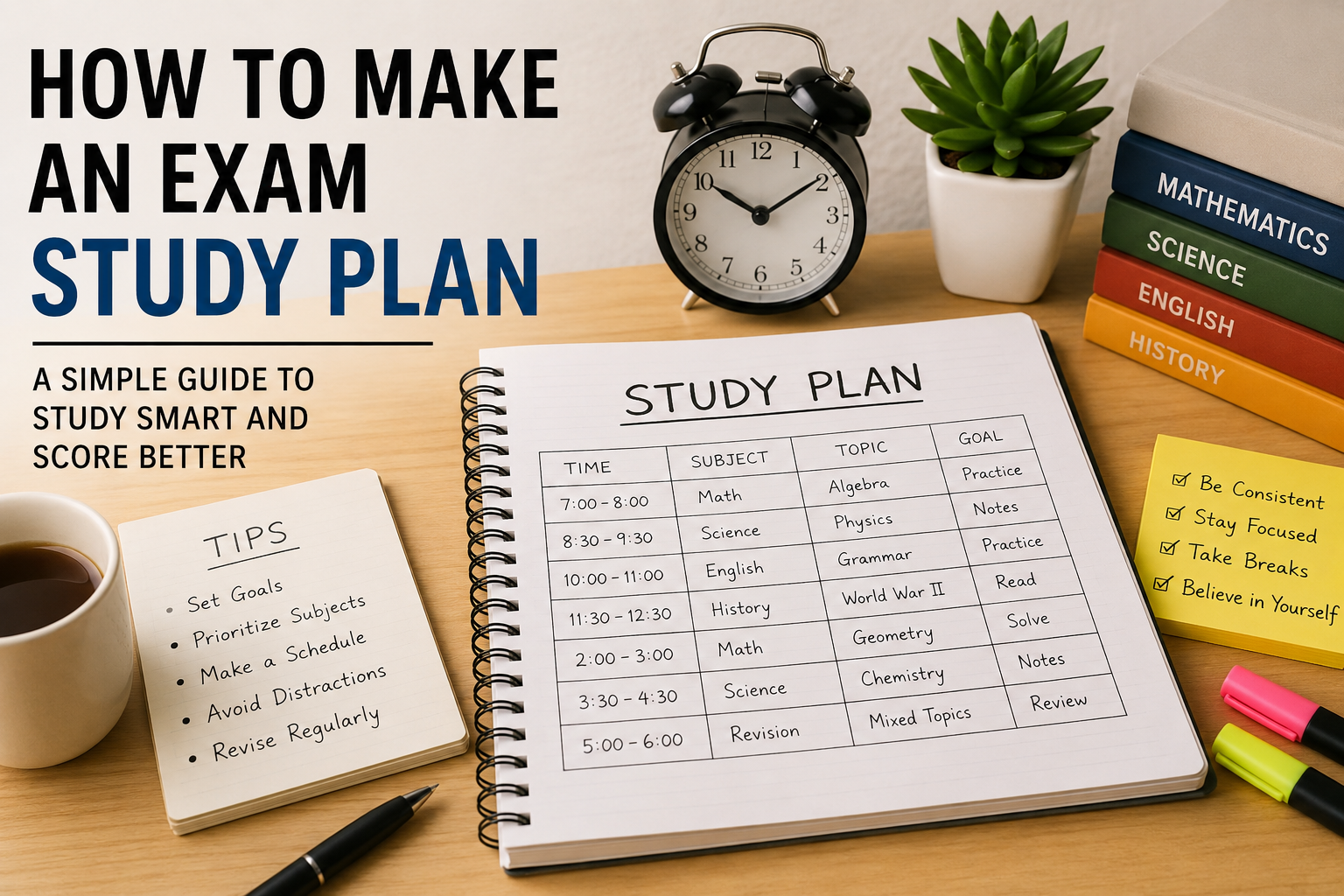
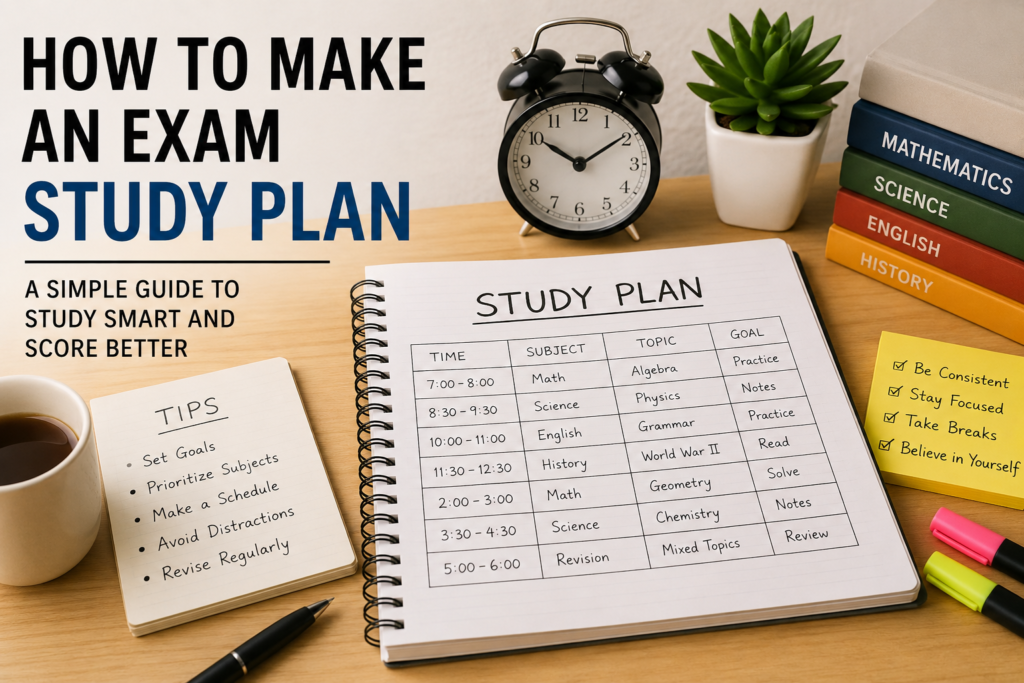
Create a Daily Study Schedule
Now you can create your daily study schedule. Decide how many hours you can realistically study each day.
Do not create a timetable that leaves no time for rest. Studying for many hours without breaks can make you tired and reduce your concentration.
For example, you might study Mathematics from 9:00 to 10:00, take a short break, then study Science from 10:20 to 11:20.
Your schedule does not have to look exactly like this. The important thing is to create a routine that matches your daily life.
If you have school, work, family responsibilities, or other activities, include them when planning your study time.
Use Study Sessions Instead of Long Hours
I find shorter focused study sessions much more useful than sitting with a book for several hours without concentration.
You can study for around forty five to sixty minutes and then take a short break. During the study session, focus only on the topic in front of you.
During breaks, get up, drink some water, walk around, or simply relax for a few minutes.
The purpose of a break is to refresh your mind. Try not to spend the entire break scrolling through social media because it can make it difficult to return to studying.
Give More Time to Difficult Topics
Your exam study plan should not divide time equally between every topic. Difficult topics often require more attention.
If you understand a chapter quickly, you can review it and move forward. If another chapter takes more time, give yourself additional study sessions.
For difficult subjects, combine reading with active practice. For Mathematics, solve questions. For Science, explain concepts in your own words. For languages, practice writing and vocabulary.
The best study method depends on the subject, so your study plan should be flexible enough to support different learning methods.
Include Revision in Your Study Plan
One mistake students often make is studying new material until the day before the exam. I believe revision should be part of your exam study plan from the beginning.
After completing a topic, review it later. You can revise important formulas, definitions, dates, vocabulary, concepts, and notes.
Regular revision helps you remember information for longer. It also shows you which topics you have forgotten and need to study again.
Try to leave some days before each exam for complete revision. During this time, focus more on reviewing than learning completely new material.
Practice With Past Papers
Past papers and practice questions can be extremely useful for exam preparation. They help you understand the style of questions and give you an opportunity to test your knowledge.
Add practice tests to your study timetable. Once you have finished a major part of your syllabus, try answering questions without looking at your notes.
After completing a practice paper, check your mistakes carefully. Do not simply look at your score. Find out why you made each mistake.
If you repeatedly make mistakes in the same topic, add that topic to your revision schedule.
Keep Your Study Plan Flexible
A study plan should guide you, not control every minute of your day.
Sometimes unexpected things happen. You may become tired, have another responsibility, or need more time to understand a difficult chapter.
If you miss one study session, do not give up on the entire plan. Move the unfinished topic to another suitable time.
I think flexibility is one of the most important parts of successful exam preparation. A perfect timetable is not useful if you cannot realistically follow it.
Avoid Distractions While Studying
A good study plan works best when you protect your study time.
Keep your phone away if you do not need it for studying. Turn off unnecessary notifications and choose a quiet place where you can concentrate.
Before starting each session, keep your books, notes, stationery, and water nearby. This reduces the need to leave your study area repeatedly.
Even small distractions can interrupt your concentration. A focused one hour can often be more productive than several unfocused hours.
Take Care of Your Health
Exam preparation is not only about studying. Your body and mind also need proper care.
Try to get enough sleep, eat regular meals, drink enough water, and take short breaks during study sessions.
Avoid staying awake all night to study. Sleep is important for concentration and memory, so sacrificing sleep may make studying less effective.
A balanced routine can help you stay focused throughout your exam preparation.
Review Your Study Plan Every Day
At the end of each day, spend a few minutes reviewing your progress.
Ask yourself what you completed, what you could not complete, and what needs more attention tomorrow.
If you completed everything, move forward according to your plan. If you missed something, adjust the next day’s schedule.
This simple habit keeps your exam study plan realistic and up to date.
Final Thoughts
Learning how to make an exam study plan does not have to be complicated. Start with your exam dates, list your subjects, divide the syllabus into smaller topics, identify difficult areas, and create realistic daily study sessions.
Make sure your plan includes revision, practice questions, breaks, and enough time for sleep. Most importantly, stay consistent. You do not need to study perfectly every day. You simply need to keep making progress.
From my point of view, the best study plan is one that you can actually follow. A simple and realistic plan is much better than a complicated timetable that becomes impossible to maintain.
If you start preparing early and follow your study schedule consistently, you can enter your exams with better preparation and greater confidence. Remember that effective exam preparation is not about studying all day. It is about using your time wisely, understanding your subjects, practicing regularly, and giving yourself enough time to revise.
With the right exam study plan, your preparation can become more organized, focused, and manageable.
Primary Keyword: How to Make an Exam Study Plan
Related Keywords: exam study plan, study plan for exams, exam preparation tips, study timetable for students, how to prepare for exams, effective study schedule, exam revision plan, study schedule for students