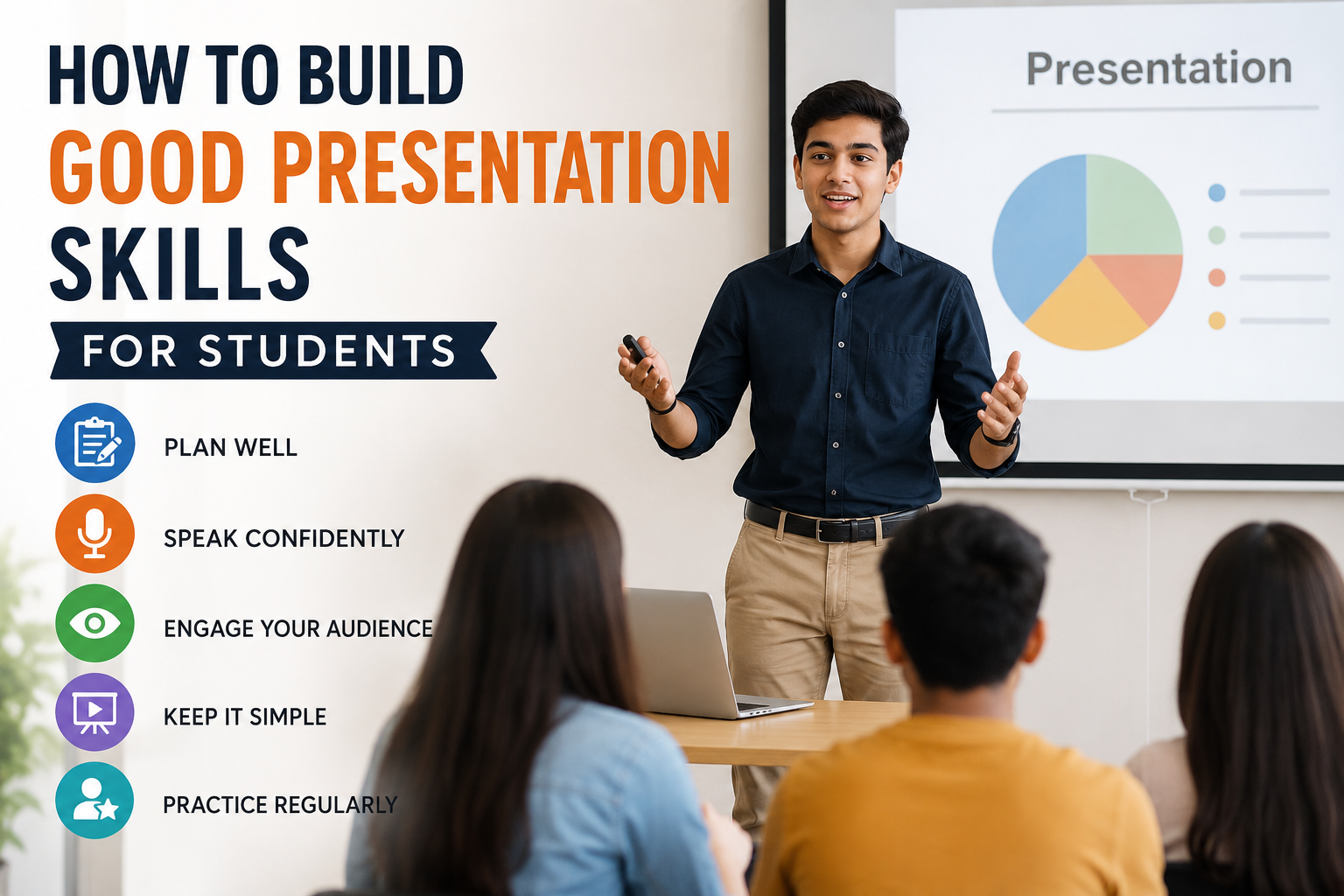
Good presentation skills are important for students because they help us express our ideas clearly and confidently. Whether we are presenting a school project, giving a class speech, explaining an assignment, or speaking in front of a group, the ability to communicate well can make a big difference.
In my opinion, presentation skills are not something that only naturally confident students can learn. Anyone can improve with practice, preparation, and patience. I have found that the biggest mistake students make is thinking that a good presentation is only about speaking without mistakes. Actually, a successful presentation is about sharing useful information in a simple and interesting way while keeping the audience involved.
In this article, I will share some practical ways students can build good presentation skills and become more confident speakers.
Understand Your Topic First
The first step toward a good presentation is understanding your topic. I believe students should never depend completely on slides or notes. If you understand the subject properly, it becomes much easier to explain it in your own words.
Before preparing your presentation, read about the topic from reliable sources. Identify the main ideas and try to understand how they connect with each other. Think about the questions your audience might ask.
When you understand your topic, you do not need to memorize every sentence. You can speak naturally because you know what you are talking about.
Know Your Audience
Another useful presentation skill is understanding your audience. The way you explain a topic to classmates may be different from the way you explain it to teachers or younger students.
Before creating your presentation, think about who will listen to you. Ask yourself what they already know about the subject and what information they need.
For example, if I am explaining a difficult academic concept to students who are new to the subject, I would use simple examples and familiar language. This makes the presentation easier to follow.
Organize Your Presentation Clearly
A well organized presentation is easier for both the speaker and the audience. I usually recommend dividing a presentation into three basic sections: introduction, main content, and conclusion.
The introduction should tell the audience what the presentation is about. You can begin with a question, interesting fact, short example, or simple statement.
The main section should contain your important points. Try to arrange your ideas in a logical order instead of jumping from one topic to another.
Finally, the conclusion should remind the audience about the main message. A strong ending can make your presentation more memorable.
Keep Your Slides Simple
Presentation slides should support your speech, not replace it. One common mistake I see among students is putting too much text on every slide.
A slide filled with long paragraphs can make the audience focus on reading instead of listening. It can also make the speaker feel tempted to read everything directly from the screen.
Instead, use short points, headings, simple diagrams, relevant images, and important keywords. Your slides should give the audience a visual guide while you explain the details.
Good presentation design does not have to be complicated. A clean layout with readable text is usually more effective than a slide filled with unnecessary decorations.
Practice Your Presentation
Practice is one of the most important ways to improve presentation skills for students. Even if you understand your topic, speaking in front of people can feel difficult without preparation.
I recommend practicing your presentation several times before the actual day. Start by speaking through the presentation alone. Then try practicing in front of a mirror or recording yourself with your phone.
When you watch the recording, pay attention to your speaking speed, pronunciation, body language, and repeated words. You may notice habits that you were not aware of before.
You can also practice in front of a friend or family member and ask them for honest feedback.
Work on Your Speaking Voice
Your voice has a major effect on how your presentation sounds. Speaking too quietly can make it difficult for people to hear you, while speaking too quickly can make your explanation difficult to understand.
Try to speak at a comfortable speed. Pause briefly after important points. Change your tone naturally instead of using the same voice throughout the presentation.
I also believe that students should practice pronunciation rather than feeling embarrassed about mistakes. Good communication is more important than having a perfect accent.
Improve Your Body Language
Presentation skills are not only about words. Body language also communicates confidence.
Try to stand straight and maintain natural eye contact with different people in the room. Avoid constantly looking at the floor, reading from your notes, or turning your back toward the audience.
Your hands can also be used naturally to emphasize important points. However, there is no need to make exaggerated movements.
A relaxed posture can make you appear more confident, even if you are feeling nervous inside.
Make Eye Contact
Eye contact helps create a connection between the speaker and the audience. When students look only at their slides, their presentation can feel disconnected.
You do not need to stare at one person continuously. Instead, look at different parts of the room for a few seconds at a time.
If direct eye contact makes you nervous, you can initially look near people’s eyes or at different points around the room. With practice, natural eye contact becomes easier.
Use Simple and Clear Language
One of the best presentation tips for students is to keep language simple. Using complicated words does not automatically make a presentation better.
Your goal should be to communicate an idea clearly. If a simple word can explain something, there is no reason to choose a difficult word.
Try to use short sentences and explain technical terms when necessary. You should speak in a way that sounds natural rather than trying to sound overly formal.
Tell Stories and Give Examples
Examples can make even a difficult topic easier to understand. Whenever possible, connect your topic with real life situations.
For example, if you are presenting about time management, you could explain how a student can organize study time before exams. A practical example gives the audience something they can relate to.
Short stories can also make presentations more interesting. You do not need to tell a long story. Even a brief personal experience or realistic situation can help people remember your main point.
Learn How to Manage Nervousness
Feeling nervous before a presentation is completely normal. Even students who appear confident may feel nervous before speaking in front of others.
Instead of trying to eliminate nervousness completely, learn how to manage it.
Before presenting, take a few slow breaths and remind yourself that you prepared for this moment. Avoid rushing through your introduction.
I also find it helpful to arrive early and become familiar with the room. Knowing where you will stand and where your presentation will appear can reduce unnecessary stress.
Remember that the audience is usually not looking for mistakes. Most people simply want to understand what you are explaining.
Avoid Memorizing Every Word
Memorizing a complete presentation may seem like a good idea, but it can create problems. If you forget one sentence, you may suddenly forget what comes next.
Instead, understand your content and remember the main points. Use brief notes containing keywords if you are allowed to use them.
This approach makes your presentation sound more natural. You can explain the same idea using slightly different words without losing your confidence.
Learn to Handle Questions
Questions are a normal part of many student presentations. You should be prepared for them.
Before your presentation, think about possible questions your audience or teacher might ask. Prepare simple answers for important areas of your topic.
If you do not know the answer to a question, do not panic. It is better to honestly say that you are not sure and explain that you would like to check the information than to give an incorrect answer.
Handling questions calmly is an important part of effective presentation skills.
Ask for Feedback
Feedback can help you improve much faster. After practicing or completing a presentation, ask someone you trust what you did well and what you could improve.
Do not take constructive criticism personally. Think of it as useful information.
For example, someone may tell you that you speak too quickly or that your slides contain too much information. These small observations can help you make your next presentation stronger.
Practice Small Speaking Activities
You do not have to wait for a major school presentation to practice. You can build presentation confidence through small daily activities.
Try explaining a topic to a friend, summarizing something you have learned, reading aloud, or speaking for two minutes about a subject you enjoy.
These simple activities gradually make speaking feel more comfortable.
Use Technology Wisely
Technology can make student presentations more engaging when used properly. Presentation software can help you create visual slides, while a phone can help you record practice sessions.
However, technology should not become the main focus. A presentation is successful because of the speaker’s communication, organization, and understanding.
Always check your laptop, presentation file, internet connection, and other equipment before presenting. If possible, keep a backup copy of your presentation.
Learn From Good Speakers
One of the easiest ways to improve is to observe people who communicate effectively. Watch educational talks, classroom presentations, interviews, or public speaking videos.
Pay attention to how speakers introduce topics, explain ideas, use pauses, move around, and interact with audiences.
Do not try to copy someone’s personality. Instead, notice techniques that you can adapt to your own style.
Final Thoughts
Building good presentation skills for students takes time, but it is absolutely possible. In my view, confidence does not come before practice. Confidence usually grows because we practice, make mistakes, learn from them, and try again.
Start with the basics. Understand your topic, organize your ideas, create simple slides, practice your speech, improve your body language, and learn to manage nervousness. Over time, these small improvements can make a noticeable difference.
Presentation skills are useful far beyond the classroom. They can help students in university, interviews, group projects, internships, and future careers. The earlier you start developing these skills, the more comfortable you can become with expressing your ideas.
You do not need to become a perfect speaker. You simply need to become a clearer, calmer, and more confident version of yourself. With regular practice and a positive attitude, anyone can build strong presentation skills.
Focus Keywords: presentation skills for students, good presentation skills, student presentation tips, presentation skills, public speaking skills for students, presentation tips for students, how to improve presentation skills, effective presentation skills, student communication skills, presentation confidence
SEO Meta Description: Learn how to build good presentation skills for students with simple tips for confidence, speaking, body language, practice, slides, and audience engagement.