
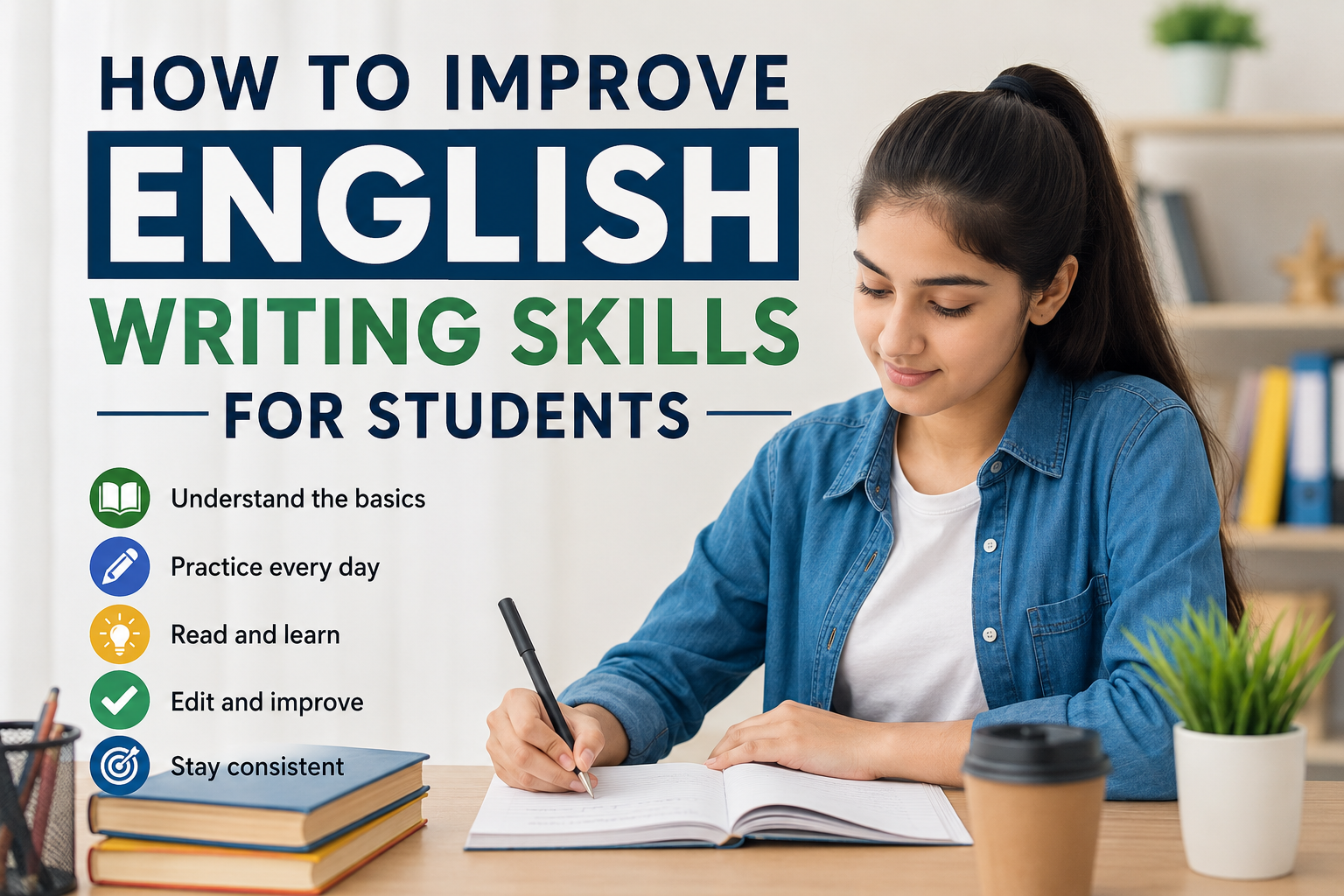
Improving English writing skills is one of the most useful things a student can do. Good writing helps students perform better in exams, complete assignments with confidence, communicate their ideas clearly, and prepare for future academic and professional opportunities. From my point of view, becoming a better English writer does not happen overnight. It comes from regular practice, reading, learning from mistakes, and developing a habit of expressing ideas in a simple and organized way.
Many students believe that they need advanced vocabulary or perfect grammar to become good writers. I do not think that is always true. In my experience, clear ideas, correct sentence structure, useful vocabulary, and consistent practice are much more important. If students follow a few simple habits every day, they can gradually improve their English writing skills.
Understand the Basics of English Grammar
The first step to improving English writing skills is understanding basic grammar. Grammar gives structure to sentences and helps readers understand what you are trying to say.
Students should learn important grammar topics such as nouns, verbs, adjectives, adverbs, pronouns, prepositions, conjunctions, and tenses. They should also understand subject verb agreement and basic sentence structure.
For example, instead of writing, “She go to school every day,” a student should write, “She goes to school every day.”
Small grammar mistakes can change the meaning of a sentence or make writing difficult to understand. This is why I believe students should spend some time learning grammar before focusing too much on complicated vocabulary.
The good thing is that students do not need to learn every grammar rule at once. Learning one topic at a time and using it in daily writing can make the process easier.
Read English Every Day
Reading is one of the best ways to improve English writing skills. When students read regularly, they naturally become familiar with sentence patterns, vocabulary, punctuation, and different writing styles.
Students can read short stories, newspapers, educational articles, books, blogs, and school materials. They do not always need to read difficult books. Simple and interesting content can also be extremely useful.
While reading, I recommend paying attention to how writers begin paragraphs, explain ideas, connect sentences, and finish their thoughts. Students can notice useful phrases and sentence structures and then try to use similar structures in their own writing.
Reading also helps students develop ideas. Sometimes the biggest problem with writing is not grammar but knowing what to write. Regular reading gives students more information and more ways to express their thoughts.
Write Something Every Day
Practice is essential when learning how to improve English writing skills. Students should try to write something every day, even if it is only a short paragraph.
For example, a student can write about their day, a favorite subject, a recent experience, a book they read, or a topic they learned in class.
Writing for fifteen or twenty minutes every day can make a noticeable difference over time. At first, students may make many mistakes. That is completely normal. The important thing is to continue practicing.
I believe students should focus on expressing their ideas first instead of worrying about every mistake. After finishing a paragraph, they can review it and correct grammar, spelling, punctuation, and sentence structure.
Learn New Vocabulary in Context
Having a good vocabulary can make English writing more interesting and precise. However, students should not try to memorize hundreds of difficult words without understanding how they are used.
Instead, I recommend learning new vocabulary from books, articles, lessons, and everyday conversations. When students find an unfamiliar word, they should learn its meaning and then create their own sentence using it.
For example, if a student learns the word “beneficial,” they can write, “Reading books is beneficial for students.”
Learning words in context makes them easier to remember. Students should also learn synonyms, but they should choose words based on meaning rather than using complicated vocabulary simply to make writing look advanced.
Clear and natural writing is usually better than writing filled with difficult words.
Improve Sentence Structure
Strong English writing requires clear sentences. Students should learn how to combine simple ideas into meaningful sentences without making them unnecessarily long.
For example, instead of writing several short sentences that repeat the same idea, students can connect related thoughts using words such as because, although, however, therefore, and while.
Students should also avoid extremely long sentences that contain too many ideas. If a sentence becomes difficult to understand, it may be better to divide it into two sentences.
A useful habit is to read each sentence after writing it. If the sentence sounds confusing, students should rewrite it in a simpler way.
Organize Your Ideas Before Writing
One common problem students face is starting to write without knowing what they want to say. This can result in disorganized paragraphs.
Before writing an essay or assignment, students should spend a few minutes planning their ideas. They can write down the main topic and then list the important points they want to discuss.
For example, if the topic is “Benefits of Reading,” students might plan three main points: improved vocabulary, better knowledge, and stronger concentration.
Once the ideas are organized, writing becomes much easier. A simple plan can also help students stay focused and avoid repeating the same information.
Learn How to Write Strong Paragraphs
A good paragraph usually focuses on one main idea. Students should begin with a clear topic sentence, explain the idea with supporting information, and finish with a suitable concluding sentence when necessary.
For example, if the paragraph is about reading, the topic sentence might introduce the importance of reading. The following sentences can explain how reading improves vocabulary and knowledge.
Students should also use transition words to connect ideas naturally. Words such as first, also, in addition, for example, however, and finally can make writing easier to follow.
From my point of view, paragraph organization is just as important as grammar because even grammatically correct writing can be difficult to understand if the ideas are poorly organized.
Practice Different Types of Writing
Students should not practice only one type of writing. Different writing activities help develop different skills.
They can practice essays, summaries, personal reflections, emails, reports, descriptions, stories, and opinion paragraphs. Each type of writing teaches students something different.
For example, essay writing helps students organize arguments, while creative writing can help them develop imagination and descriptive language. Writing summaries teaches students how to identify important information and explain it briefly.
Practicing different formats can also prepare students for school and college assignments.
Review and Edit Your Writing
One of the most important habits for better writing is editing. Students should never assume that their first draft is perfect.
After writing, they should read the work again and look for grammar mistakes, spelling errors, missing punctuation, repeated words, and unclear sentences.
I personally believe that editing can sometimes improve a piece of writing more than writing the first draft. When students review their work carefully, they begin to notice mistakes that they did not see while writing.
It can also help to read the writing aloud. When students hear their sentences, they may notice awkward phrases or sentences that do not sound natural.
Learn From Your Mistakes
Mistakes are an important part of learning English writing. Students should not feel embarrassed when teachers correct their work.
Instead, they should keep a record of common mistakes. For example, if a student frequently makes mistakes with past tense, they can spend extra time practicing past tense sentences.
The goal should not be to avoid every mistake immediately. The goal should be to make fewer mistakes over time.
A student who regularly learns from corrections can make significant progress.
Use Writing Tools Carefully
Grammar and spelling tools can be useful for students. They can help identify possible grammar, spelling, and punctuation problems.
However, students should not depend completely on these tools. The purpose of using a writing tool should be to learn from corrections rather than simply accepting every suggestion.
Students should ask themselves why a correction was made. This helps them understand their mistakes and avoid repeating them.
Technology can support learning, but regular practice and personal understanding remain essential.
Get Feedback From Teachers and Friends
Feedback can help students see problems they may not notice themselves. Students can ask teachers, classmates, or trusted friends to review their writing.
Instead of simply asking, “Is this good?” students should ask specific questions. They can ask whether their ideas are clear, whether the paragraphs are organized, or whether there are repeated grammar mistakes.
Constructive feedback can provide new ideas for improvement and increase confidence.
Make Writing a Daily Habit
The most important advice I can give students is to stay consistent. Improving English writing skills requires time and patience.
Students do not need to write a long essay every day. Even a short paragraph can be useful. The important thing is to make writing a regular part of their routine.
A student might spend ten minutes reading, fifteen minutes writing, and five minutes reviewing mistakes. This simple routine can gradually improve grammar, vocabulary, sentence structure, and confidence.
Final Thoughts
Learning how to improve English writing skills for students does not have to be difficult. The key is to start with the basics and build good habits gradually.
Students should learn basic grammar, read English regularly, practice writing every day, develop useful vocabulary, organize their ideas, write clear paragraphs, and carefully review their work. They should also learn from mistakes and use feedback as an opportunity to improve.
In my opinion, confidence comes naturally when students practice consistently. Nobody becomes an excellent writer after writing only one essay. Writing is a skill that develops through repetition and patience.
If students make English writing practice part of their daily routine, they can become better at expressing their thoughts, writing assignments, preparing for exams, and communicating with others. The most important thing is simply to begin, keep practicing, and never be afraid of making mistakes.