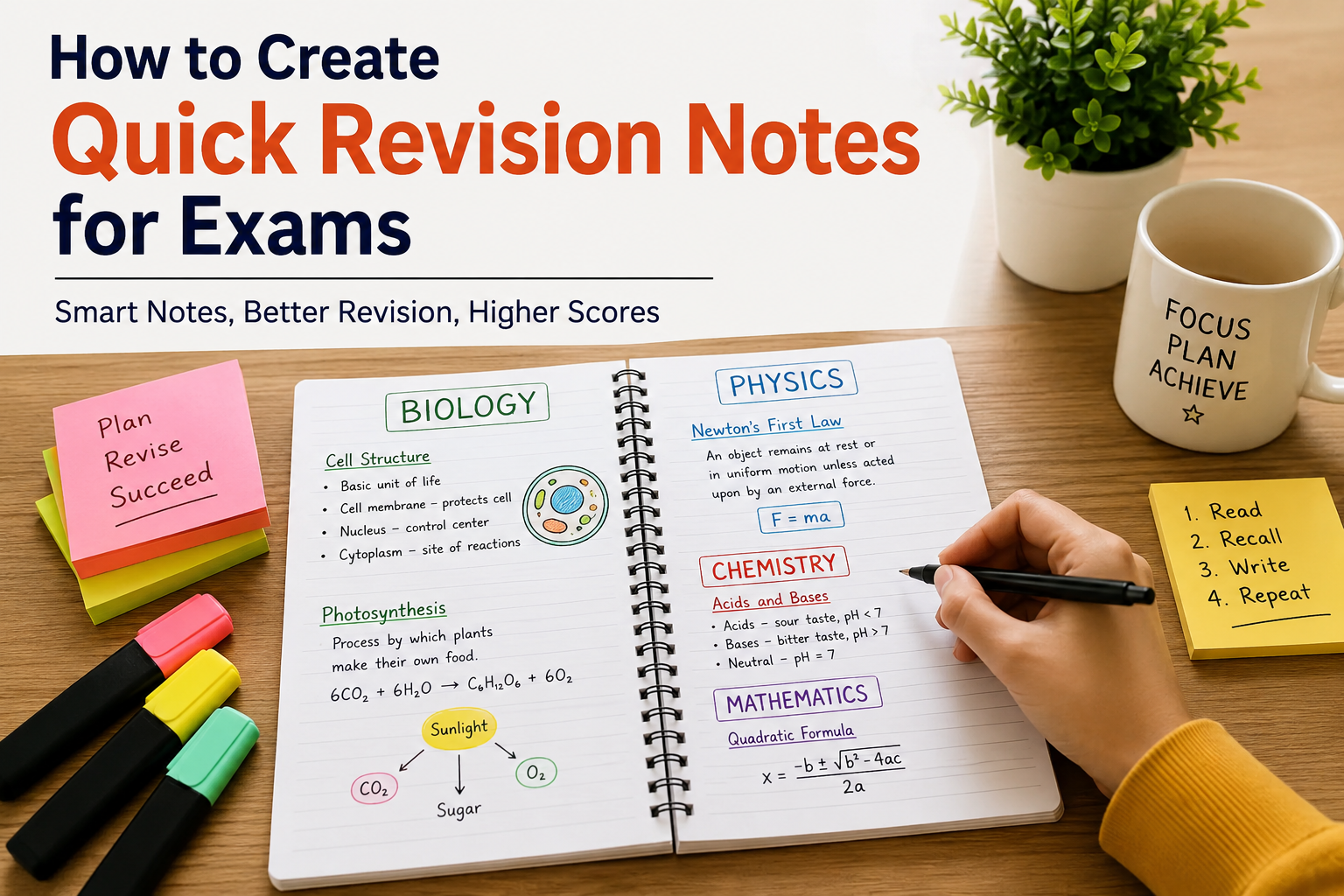
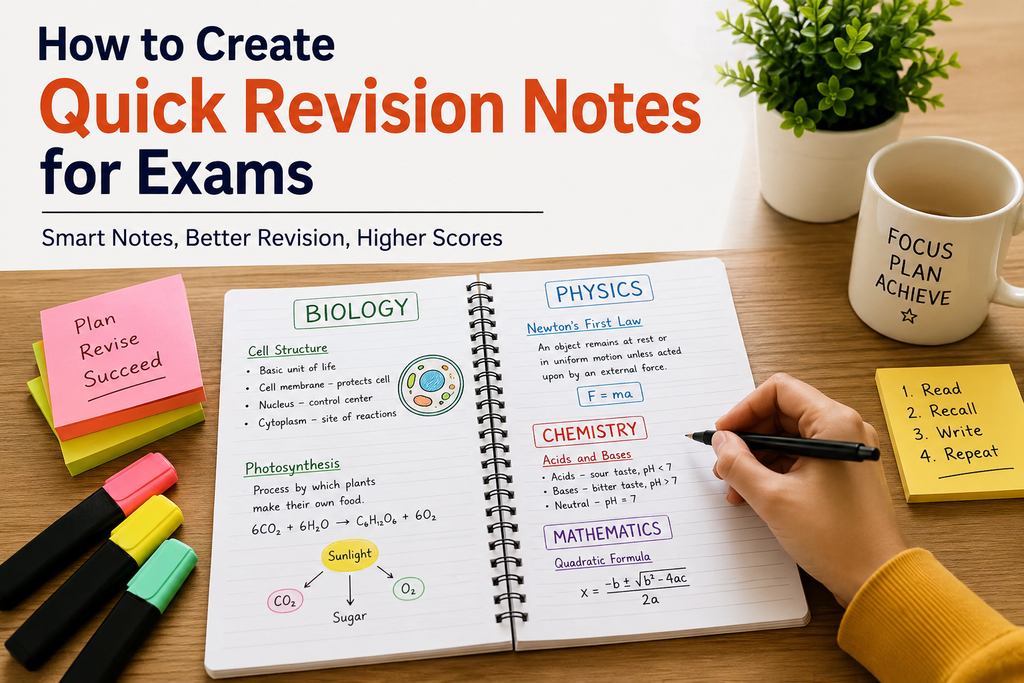
Preparing for exams can sometimes feel overwhelming, especially when there are many chapters, concepts, definitions, formulas, and important details to remember. I have found that one of the easiest ways to make exam preparation more manageable is to create quick revision notes. Good revision notes can save time, improve memory, and make it easier to review an entire subject before an exam.
The purpose of quick revision notes is not to rewrite your complete textbook. Instead, the idea is to collect the most important information in a simple and organized format that you can review whenever you have limited time. In my experience, the best notes are short, clear, and written in a way that makes sense to me.
What Are Quick Revision Notes?
Quick revision notes are short study notes that contain the key information from a particular topic or chapter. They may include important definitions, formulas, dates, concepts, examples, keywords, diagrams, and questions.
The main purpose of these notes is to help you revise quickly without reading the entire textbook again. When exams are approaching, having organized revision notes can make your study sessions much more productive.
For example, instead of reading twenty pages about a science chapter, I can use one or two pages of revision notes to remind myself about the main concepts. This saves time and helps me focus on areas that need more attention.
Start With Your Syllabus
Before creating revision notes, I recommend checking your syllabus. The syllabus gives you a clear idea of what you actually need to study.
I usually divide the subject into chapters and smaller topics. This prevents me from creating notes for information that is not relevant to the exam.
Write down every chapter and mark the topics that are important. If your teacher has highlighted particular questions or concepts during classes, include them in your revision plan.
Having a syllabus based approach also helps you track your progress. Once you complete notes for a chapter, you can mark it as finished and move to the next one.
Read the Topic Before Making Notes
One common mistake students make is trying to write notes while reading a topic for the first time. I believe it is better to understand the material first.
Read the topic carefully and try to understand the main idea. After that, identify the information that is worth remembering.
Ask yourself simple questions such as:
What is the main concept?
Which definitions are important?
Are there any formulas?
What facts could appear in the exam?
Are there examples that make the topic easier to understand?
This approach helps you avoid copying unnecessary information into your revision notes.
Keep Your Notes Short
The most important rule for creating quick revision notes is to keep them short.
If your revision notes become almost as long as the textbook, they are no longer quick revision notes. The goal is to reduce information while keeping the important points.
I prefer using short sentences and keywords instead of writing long paragraphs. For example, instead of explaining a definition in five lines, I write the key meaning in one or two simple sentences.
Try to remove repeated information and unnecessary examples. Keep only the details that help you understand or remember the topic.
Use Headings and Subheadings
Good organization makes revision much easier. I like to divide my notes using clear headings and subheadings.
For example, a history topic could be organized like this:
Causes
Important reasons behind the event.
Major Events
The most important developments.
Results
The major effects and outcomes.
Important Dates
Dates that need to be remembered.
This structure allows me to find specific information quickly. Instead of searching through a full page, I can immediately locate the section I need.
Use Keywords
Keywords are extremely useful when creating quick revision notes. They allow you to remember a larger concept using only a few words.
When I read a chapter, I look for words that represent important ideas. I then include these words in my notes.
For example, if you are studying photosynthesis, useful keywords might include sunlight, chlorophyll, carbon dioxide, water, glucose, and oxygen.
When you see these keywords during revision, they can help you remember the complete concept.
Write Important Definitions
Definitions are often important in exams, particularly in science, mathematics, business, economics, and other academic subjects.
I recommend keeping important definitions together in your revision notes. Write them in simple language while keeping the essential meaning accurate.
You can also highlight key words within the definition. This makes the information easier to recognize when you revise.
Do not write every definition from the textbook. Focus on the definitions that are included in your syllabus or frequently discussed by your teacher.
Include Formulas and Rules
For subjects such as mathematics, physics, chemistry, accounting, and economics, formulas should have their own section.
Write each formula clearly and include a short explanation of what the symbols mean if necessary.
For example, in mathematics, you might write the formula first and then include a small example underneath it.
This makes formula revision much faster before an exam. Instead of searching through several chapters, you can review the formulas from one organized page.
Use Tables for Comparisons
Tables can be very helpful when you need to compare two or more concepts.
For example, if you are studying two types of processes, you can create columns for their definition, characteristics, examples, and differences.
A comparison table can turn a complicated topic into something much easier to understand.
I find this especially useful when studying topics that contain similar terms. Seeing the differences side by side makes them easier to remember.
Add Simple Diagrams
Some subjects are easier to remember visually. If a topic contains a process, structure, cycle, or relationship, consider adding a simple diagram.
You do not need to create an artistic masterpiece. The diagram only needs to help you understand the information.
For example, biology students can use diagrams for cell structures, while geography students can use maps and processes. Science students can use simple flow diagrams to explain different stages.
Visual revision notes can make difficult information easier to recall.
Highlight Only Important Information
Using too many colors can make notes confusing. I prefer using a small number of colors for specific purposes.
For example, one color can be used for headings, another for formulas, and another for particularly important terms.
You can also underline important information instead of highlighting everything.
If every sentence is highlighted, nothing looks important. The purpose of highlighting is to make key information stand out.
Create One Page Notes for Each Chapter
One useful technique is to create a one page revision sheet for each major chapter.
Try to include the main definitions, formulas, keywords, important facts, diagrams, and possible exam questions on that page.
Creating one page notes forces you to decide what information is actually important. It also gives you something extremely useful for last minute revision.
When you have limited time before an exam, these pages can become your primary revision material.
Add Possible Exam Questions
Another technique I find helpful is adding possible exam questions to my notes.
After completing a topic, think about the questions your teacher might ask. Write a few questions and place short answers underneath them.
You can also review previous exam papers to identify repeated question patterns.
This changes revision from passive reading into active learning. Instead of simply looking at information, you are trying to remember and explain it.
Use Your Own Words
I believe revision notes work best when they are written in your own words.
Copying entire paragraphs from a textbook may save time initially, but it does not always help with understanding. When you explain a concept in your own language, you have to process the information.
For example, read a difficult paragraph and then close the book. Try to explain the concept as if you were teaching it to a friend. Write that explanation in your notes.
This can improve both understanding and memory.
Review Your Notes Regularly
Creating revision notes is only the first step. You also need to use them regularly.
I recommend reviewing your notes shortly after learning a topic. Then review them again after a few days and later before the exam.
During each revision session, try to recall the information before looking at the answer.
If you cannot remember something, check your notes and try again. This method can be more effective than simply reading the same page repeatedly.
Keep a Separate List of Weak Areas
While revising, you will probably discover that some topics are easier than others.
Create a small section called weak areas. Whenever you forget a formula, definition, concept, or process, add it to this section.
This helps you focus your study time where it is actually needed.
There is no point spending most of your revision time reading topics you already understand while ignoring difficult areas.
Avoid Making Notes Too Late
One mistake I have seen many students make is waiting until the night before the exam to create all their notes.
This can create unnecessary pressure. Quick revision notes are much more useful when they are created gradually during the study period.
You do not need to make perfect notes immediately. Start with the important information and improve them as you learn more.
By the time exams arrive, your revision material will already be prepared.
Final Thoughts
Creating quick revision notes for exams does not have to be complicated. The main goal is to turn large amounts of study material into short, organized, and useful information.
I recommend starting with your syllabus, understanding each topic before writing, using keywords, keeping notes short, adding formulas and diagrams, and including possible exam questions. Most importantly, write your notes in your own words so they are easy for you to understand.
Good revision notes are not about making beautiful pages. They are about making your study material easier to remember and faster to review.
When you create useful notes consistently, exam preparation can become more organized and less stressful. A few well planned pages can sometimes save hours of unnecessary reading and help you enter the exam with greater confidence.