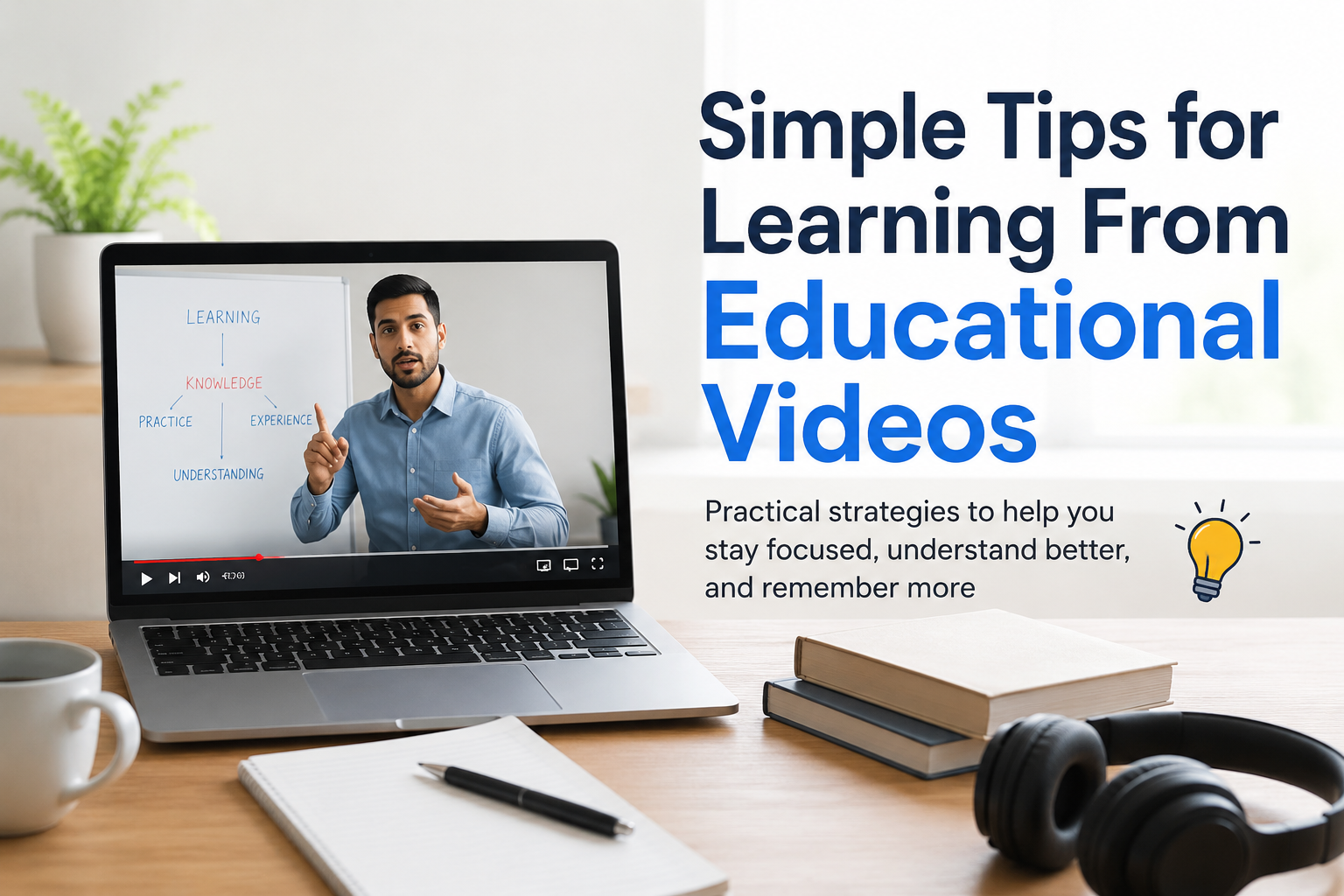
Educational videos have become one of my favorite ways to learn something new. Instead of reading long chapters or sitting in a classroom for hours, I can watch a video, see an explanation, and understand difficult ideas in a much simpler way. Today, students and learners can find educational videos about almost every subject, from mathematics and science to technology, languages, history, business, and personal development.
However, simply watching an educational video does not always mean that I am actually learning. Sometimes I watch a complete video and feel like I understood everything, but a few hours later I cannot remember the important points. This is why I believe that the way we watch educational videos matters just as much as the quality of the video itself.
In this article, I will share some simple tips for learning from educational videos more effectively. These methods are easy to follow and can help students, beginners, and anyone who wants to improve their learning habits.
Choose the Right Educational Video
The first step is choosing an educational video that matches my learning goal. There are thousands of videos available online, but not every video is useful for every learner.
Before starting a video, I try to understand what I actually want to learn. For example, if I want to understand basic algebra, I should look for a beginner friendly algebra lesson instead of choosing an advanced lecture.
I also pay attention to the title, description, instructor, and overall structure of the video. A good educational video should explain the topic clearly and provide useful examples.
Choosing the right learning video saves time and makes the entire learning process easier.
Set a Clear Learning Goal
One of the simplest learning tips I can follow is setting a goal before watching the video.
Instead of thinking, “I am going to watch a video about science,” I can create a more specific goal such as, “I want to understand how photosynthesis works.”
A clear goal gives my brain something specific to focus on. It also makes it easier to decide whether I actually learned something after the video ends.
I recommend writing one or two questions before starting. While watching, I can look for the answers to those questions. This turns passive video watching into active learning.
Watch With Full Attention
Distractions are one of the biggest problems when learning from educational videos. It is easy to open a video and then start checking messages, social media, or other websites.
When I want to learn something important, I try to remove unnecessary distractions. I put my phone away, close unrelated browser tabs, and focus only on the lesson.
Even a short educational video can provide a lot of information. If my attention is divided, I may miss important explanations.
Full attention does not mean that I have to study for several hours without a break. It simply means giving the lesson my complete focus for the time I have decided to study.
Take Simple Notes
Taking notes is another effective way to learn from educational videos. I do not try to write down every sentence because that can make learning stressful.
Instead, I focus on important ideas, definitions, examples, formulas, and questions.
For example, if I am watching a video about effective study habits, I might write down the three most useful techniques mentioned by the instructor. Later, I can review those points without watching the entire video again.
Simple notes also help me process information instead of simply hearing it.
Pause and Replay Difficult Parts
One major advantage of educational videos is that I can control the pace. If I do not understand something, I can pause the video and watch that section again.
In a traditional classroom, I might hesitate to ask the teacher to repeat something several times. With online educational videos, I can replay difficult sections as many times as necessary.
I usually recommend slowing down when a topic becomes complicated. Understanding one difficult concept is more valuable than quickly finishing an entire video.
There is no benefit in completing a thirty minute video if I cannot explain what I learned afterward.
Avoid Watching Too Many Videos at Once
It can be tempting to watch several educational videos about the same topic. More information may seem better, but sometimes it creates confusion.
I prefer to watch one good video first and make sure I understand the main ideas. After that, I can use another video to clarify something that remains confusing.
This approach prevents information overload and makes learning more organized.
The goal is not to collect as many videos as possible. The goal is to understand and remember useful information.
Use Playback Speed Wisely
Video playback speed can also affect learning. Some learners prefer normal speed, while others understand better when a lesson is slightly faster or slower.
If the instructor speaks slowly and the topic is easy for me, increasing the speed may save time. If the subject is complicated, I may slow the video down.
However, I do not recommend increasing the speed simply to finish the video faster. Learning should always be more important than completing a certain number of minutes.
The best learning speed is the one that allows me to understand the information comfortably.
Stop and Explain What You Learned
One of the most useful educational video learning techniques is stopping occasionally and explaining the lesson in my own words.
After an important section, I can pause the video and ask myself, “What did I just learn?”
If I can explain the idea without looking at my notes, it usually means I have understood it reasonably well.
If I cannot explain it, I know that I need to review that section again.
This simple technique can turn passive watching into active learning.
Practice After Watching
Watching an educational video is only the beginning. Practice is what helps turn information into a useful skill.
For example, if I watch a mathematics lesson, I should solve some problems afterward. If I watch a programming tutorial, I should write some code myself. If I watch a language lesson, I should practice speaking or writing.
The type of practice depends on the subject, but the principle is the same. I should use what I learned instead of only watching someone else do it.
Practice also shows me which areas I understand and which areas need more attention.
Review Your Notes Later
Information can be forgotten when I do not review it. For this reason, I like to return to my notes after some time.
The review does not need to be long. Even a few minutes can help remind me of the main ideas.
I can read my notes the same evening, the next day, or several days later. During the review, I can try to remember the information before looking at the answer.
Regular review is especially helpful for students preparing for exams or anyone learning a skill over a long period.
Connect New Information With What You Already Know
Learning becomes easier when I connect new information with something I already understand.
For example, when learning a new technology concept, I can compare it with a familiar technology. When learning a historical event, I can connect it with other events I already know.
These connections give new information a place in my existing knowledge.
Instead of memorizing isolated facts, I try to understand how different ideas relate to each other.
Ask Questions While Watching
Good learners do not simply accept every piece of information without thinking about it. I find it useful to ask questions while watching educational videos.
Questions such as “Why does this happen?”, “How does this work?”, and “Where can I use this information?” encourage deeper thinking.
If the video does not answer a question, I can research it later using reliable educational sources.
Questions can make an ordinary video feel more like a personal lesson.
Create a Simple Learning Routine
Consistency is more important than studying for a very long time once in a while.
I would rather watch one useful educational video every day and review what I learned than watch ten videos in one day and forget most of them afterward.
A simple routine could include choosing a topic, watching one video, taking notes, reviewing the main points, and practicing the new skill.
This routine does not need to take hours. Even twenty to thirty minutes of focused learning can be useful when done consistently.
Do Not Be Afraid to Start Again
Sometimes a topic is simply difficult. If I watch a video and understand only half of it, that does not mean I am bad at learning.
Some subjects require several explanations before they become clear.
I can watch another educational video, read a simple article, ask questions, or return to the original lesson later.
Learning is a process, and confusion is often a normal part of that process.
Final Thoughts
Educational videos can be an excellent learning resource when they are used correctly. In my experience, the biggest difference comes from being active rather than passive.
Choosing the right video, setting a clear learning goal, taking simple notes, pausing difficult sections, asking questions, and practicing afterward can make educational videos much more valuable.
I also believe that finishing a video should not be the main goal. Understanding the information and being able to use it is much more important.
With a little focus and consistency, educational videos can become a powerful part of a daily learning routine. Whether I am a student preparing for exams, a beginner learning a new skill, or simply someone who enjoys gaining knowledge, these simple learning techniques can help me get more value from every educational video I watch.